


Key Takeaways
- A non-alcoholic Old Fashioned works when the base spirit delivers real oak, vanilla, spice, and body to stand in for ethanol.
- The Old Fashioned is the toughest NA cocktail because it has no citrus, mixer, or dilution buffer, so the base spirit carries flavor and texture.
- Strong candidates for stirred NA drinks show oak-vanilla-spice notes, real viscosity for 1:1 mixing, very low sugar, and controlled heat without artificial sweetness.
- Little Saints St. Oak checks these boxes with oak, vanilla, cardamom, and caramel notes, zero sugar, 1:1 mixing, and functional botanicals including Lion’s Mane, Damiana, and Reishi.
- Little Saints offers a whiskey-adjacent NA spirit designed for a balanced, low-sugar non-alcoholic Old Fashioned that behaves like the classic.
Why The Old Fashioned Stresses Non-Alcoholic Spirits
Most non-alcoholic cocktail conversions have somewhere to hide. A margarita has lime juice. A gin and tonic has tonic. A spritz has bubbles and bitterness. The Old Fashioned has none of those buffers. It is spirit, sugar, bitters, and water, and three of those show up in tiny quantities. The base spirit does almost all of the work.
In a traditional build, bourbon or rye contributes warmth, vanilla-caramel-oak character, and significant body. Ethanol delivers heat, builds body, carries aroma, and balances flavor. A non-alcoholic formulation has to rebuild those jobs by hand. When ethanol disappears and flavored water takes its place, every flaw shows up immediately. The drink turns thin and artificially sweet, the finish goes flat, and the bitters land harshly with nothing to carry them.
The Old Fashioned therefore becomes a demanding test for any NA spirit. A bottle that tastes fine in a highball, where soda and citrus cover a multitude of sins, often falls apart in a stirred drink. The selection criteria for a non-alcoholic spirit built for an Old Fashioned are stricter than for almost any other application. The full guide to building a low-sugar non-alcoholic Old Fashioned covers the technique in detail, and that technique only works when the bottle choice is sound.
What To Look For In A Non-Alcoholic Spirit For A Stirred Drink
Most roundups list bottles without explaining why one works in a stirred drink and another fails. These are the attributes that actually matter.
Oak, vanilla, caramel, and spice. These are the flavor compounds that barrel aging extracts from wood over time. Research by the Scotch Whisky Research Institute confirms that 70% of oak-derived flavor compounds such as eugenol and vanillin extract within the first 24 months of aging. A non-alcoholic spirit built for whiskey applications needs to recreate this flavor architecture with botanical extracts. Without oak and vanilla, the drink reads as generic. Without spice, it has no finish.
Body and viscosity. Thinness is the single biggest reason early non-alcoholic spirits disappointed bartenders and consumers. Ethanol at 40% ABV contributes real viscosity and mouth-coating weight. Bartenders who tested first-generation NA spirits often described them as flavored water. They dilute in a cocktail and force a two-to-three-times pour. Oil-based craft extracts hold up in a build and mix 1:1. That distinction matters in a stirred drink, where dilution is controlled and intentional.
A 1:1 mixing ratio. When a spirit needs double or triple the pour to deliver flavor, the economics and the build both break. Two ounces of bourbon in an Old Fashioned should be replaced by two ounces of NA spirit. A bottle that mixes 1:1 also lasts as long as the bottle it replaces, which matters at home and behind a bar.
Heat and finish. The warmth at the back of the throat signals that the drink is a cocktail rather than a soft drink. Well-formulated NA spirits recreate that warmth with capsicum-derived heat and botanical irritants, and the dose has to be precise. Too little and the drink reads as juice. Too much and it reads as hot sauce.
Zero or near-zero sugar. Traditional bourbon contains zero grams of sugar. Distillation separates ethanol from the fermented grain mash and leaves the distilled spirit with negligible residual sugar. An Old Fashioned already adds sweetener deliberately. A NA spirit that arrives pre-sweetened throws the balance off before the build even starts. Sugar content in the base spirit is the adjustment point most home drinkers miss entirely. How to choose non-alcoholic spirits that actually deliver covers this selection layer in full.
The Shortlist: Non-Alcoholic Spirits That Work In An Old Fashioned
The NA spirit category now spans bourbon-forward expressions, smoky and spicy profiles, and layering approaches that combine multiple bottles. For a classic Old Fashioned, the bourbon-forward category is the correct starting point, and within it, one bottle is built specifically for this application.
Little Saints St. Oak is that whiskey-adjacent bottle. It captures the notes of an oak-aged whiskey: vanilla, spice, and woodsy depth from oak, vanilla, cardamom, and caramel. It also carries all three of the brand's functional botanicals: organic Lion's Mane, Damiana, and organic Reishi. It was named Best NA Spirit of 2025 by the BevNET Spirit Awards.
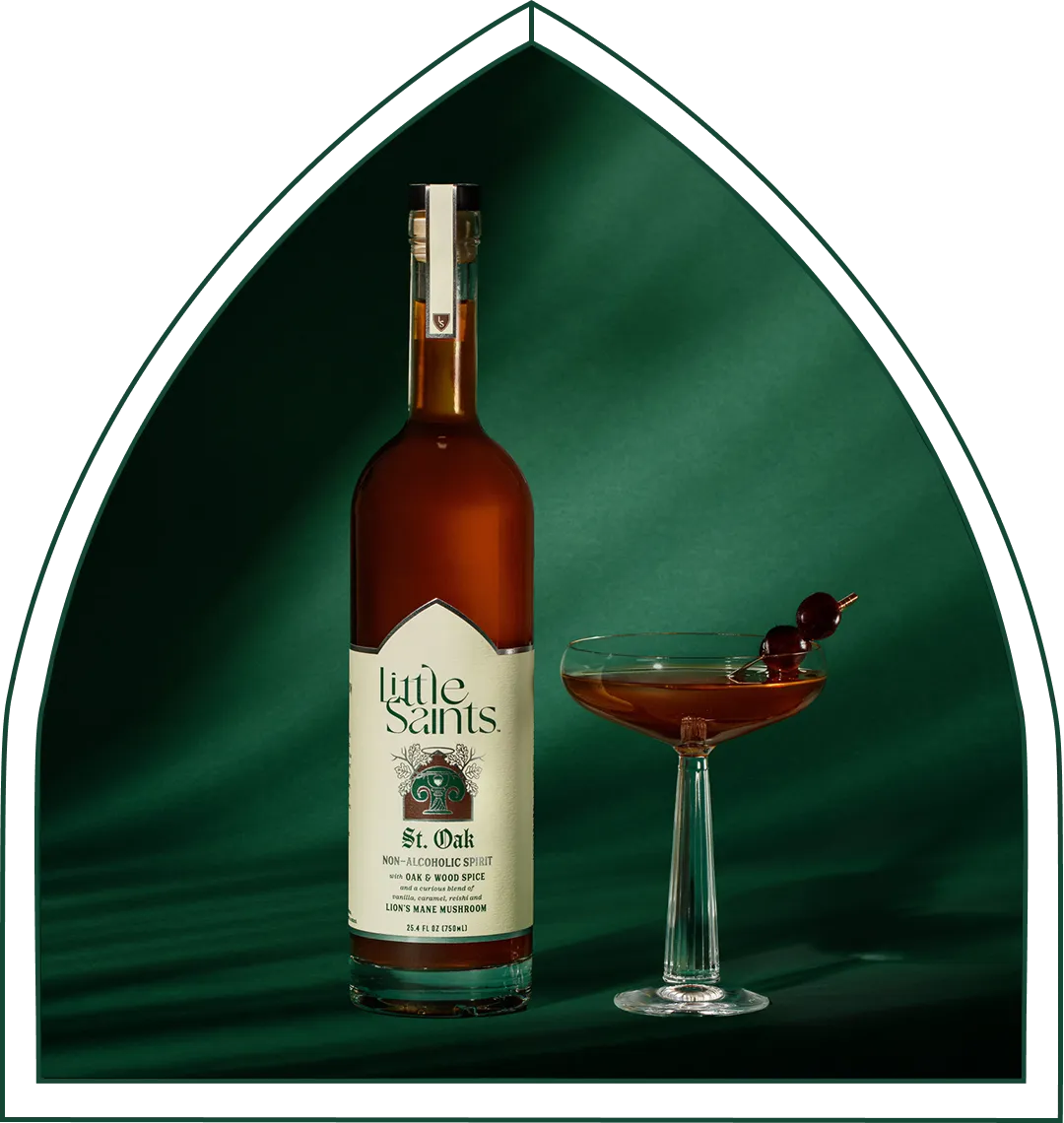
St. Oak mixes like a whiskey. Substitute two ounces for two ounces in an Old Fashioned, Manhattan, or Boulevardier. It carries zero grams of sugar with no sweeteners of any kind, which matters in a three-ingredient drink where sugar is already a deliberate variable. The heat comes from capsicum. The body comes from oil-based craft extracts and the natural viscosity of the Lion's Mane extract, which also produces the spirit's characteristic cloudiness. That cloudiness signals that the functional ingredient is present at a real dose.
The functional dose appears on the label: 100mg of organic Lion's Mane extract per serving at a minimum of 70% beta glucan. Beta glucan is the fraction of the mushroom that carries its adaptogenic properties and is documented by certificates of analysis from the supplier. The mushrooms are USDA Organic, grown in California, and extracted with ultrasound rather than chemical solvents.
These statements have not been evaluated by the FDA. This product is not intended to diagnose, treat, cure or prevent any disease.
For a smoky or spicy variation, a bourbon-forward base can be layered with a mezcal-style NA spirit to add depth. For a fully 0.0% build, St. Oak pairs with alcohol-free aromatic bitters, covered in the bitters section below.
Non-alcoholic spirits that mix 1:1 in cocktails provides a tested comparison of how oil-based extracts perform against first-generation NA spirits in stirred builds.
Try St. Oak In Your Next Old Fashioned
0.0% Vs 0.5% ABV: How To Read NA Spirit Labels
Most NA spirits sit under 0.5% ABV, the federal threshold below which a non-malt beverage is regulated by the FDA as food rather than by the TTB as alcohol. Within that range, products vary. Some are formulated at 0.0% ABV, meaning no alcohol was ever present. Others retain trace amounts from botanical extraction processes and sit between 0.01% and 0.49% ABV.
Little Saints spirits, including St. Oak, are under 0.5% ABV. The brand's canned cocktails are 0.0% ABV.
For most home drinkers, the practical difference between 0.0% and under 0.5% ABV is negligible. A standard 2 oz pour of a 0.4% ABV spirit delivers roughly 0.19 g of pure alcohol. That is a fraction of the alcohol in a typical ripe banana, which contains about 0.2–0.4 g per 100 g. A very ripe banana can reach about 0.5 g. For anyone avoiding alcohol for medical, religious, or pregnancy-related reasons, 0.0% is the correct choice, and the canned Little Saints Old Fashioned at 0.0% ABV covers that occasion directly. For cocktail building at home where flavor and performance come first, the spirits line at under 0.5% ABV is the right tool.
US labeling rules distinguish "alcohol-free" (0.0% ABV) from "non-alcoholic" (under 0.5% ABV). That distinction matters when you read labels.
How To Make A Non-Alcoholic Old Fashioned
The build below is a spec, not a suggestion. The most common failure point for home drinkers is using the same sugar quantity as a classic Old Fashioned. NA spirits run sweeter than real whiskey for two reasons. They carry botanical extracts that contribute natural sweetness, and without ethanol's drying effect, that sweetness registers more prominently on the palate. A standard 1 oz pour of simple syrup contains approximately 12 grams of sugar. The sweetener, not the base spirit, is the dominant sugar variable in a stirred drink, so reduce it.
- Chill your glass. Place a rocks glass in the freezer for five minutes, or fill it with ice water while you build the drink. A cold glass slows dilution and keeps the drink in balance longer.
- Add sweetener with a light hand. Use ¼ teaspoon of demerara syrup (2:1 demerara sugar to water) rather than the ½ teaspoon or full sugar cube a classic recipe calls for. Demerara's molasses note adds complexity that plain simple syrup lacks. If St. Oak tastes sweet enough on its own in your build, reduce the syrup further or omit it entirely on a second pour.
- Add 2–3 dashes of aromatic bitters. Angostura works. Two dashes is the floor, and three is correct for most palates. See the bitters section below for a fully 0.0% alternative.
- Add 2 oz Little Saints St. Oak. Pour two ounces, the same measure as the bourbon it replaces. No over-pouring required.
- Stir for 20 seconds over ice. Use a mixing glass and bar spoon. Twenty seconds delivers controlled dilution, roughly a 15–20% water increase, which opens the aromatics without washing out the flavor. Do not shake. Shaking aerates the drink and produces a cloudy, frothy result that does not fit this build.
- Strain over a large cube. A single large cube melts slowly and maintains dilution control through the drink. Cracked or small ice melts fast and turns the drink watery before the glass is half empty.
- Express an orange peel. Hold a wide strip of orange peel, pith side down, over the glass and squeeze sharply to release the oils. Run the peel around the rim, then drop it in or rest it on the cube. The expressed oils provide the aromatic top note of the drink, so keep this step.
The less-sugar adjustment is the gap most recipe roundups miss. That single change often separates a balanced drink from a sweetened NA beverage with bitters in it.
Bitters: The Small Pour That Makes The Drink
Bitters are the structural element that makes an Old Fashioned an Old Fashioned rather than a sweetened spirit on ice. Traditional Angostura aromatic bitters work in this build at two to three dashes, used as written above. Angostura contains alcohol at approximately 44.7% ABV by volume in the bottle, but at two to three dashes the contribution to the finished drink's blood alcohol concentration (BAC, or blood alcohol concentration) is negligible for most drinkers.
For a fully 0.0% build, alcohol-free aromatic bitters exist and perform well in this application. Fee Brothers Whiskey Barrel-Aged Bitters sit at approximately 4% ABV, low enough to qualify as effectively alcohol-free in a standard pour. Dedicated 0.0% aromatic bitters are also available from several producers and can be substituted at the same dash count. Orange bitters, alcoholic or alcohol-free, work as a secondary addition or a standalone alternative for a brighter, citrus-forward profile.
Whatever bitters you use, keep them in the build. A stirred NA spirit with sweetener and no bitters is a different drink. The bitters provide the bitterness that balances the sweetness and the aromatic complexity that makes the drink worth drinking.
How To Order A Non-Alcoholic Old Fashioned At A Bar
The same build that works at home also guides how you order at a bar. Non-alcoholic Old Fashioneds are increasingly available at A- and B-tier bars, but the menu language varies. The clearest order is direct: ask for a non-alcoholic Old Fashioned built with a whiskey-style NA spirit, two ounces, aromatic bitters, minimal sweetener, stirred, large cube, orange peel expressed. If the bar stocks Little Saints St. Oak, ask for it by name.
If the bar does not have a dedicated NA spirit, a well-made non-alcoholic Old Fashioned is not realistic. A bartender cannot build a stirred whiskey drink without a whiskey-adjacent base. In that case, the canned Little Saints Old Fashioned (0.0% ABV, zero sugar, five calories) is a direct alternative that requires no build and no bar equipment.
NIQ data shows that 47% of on-premise visitors mix alcoholic and non-alcoholic drinks in the same occasion. That zebra-striping behavior is now ordinary. Ordering a non-alcoholic Old Fashioned at a bar is simply a drink order.
Stock The Bottle Behind The Bar
Comparison: St. Oak Vs. First-Generation NA Spirits Vs. Traditional Bourbon
The table below shows why St. Oak behaves like a whiskey in a stirred drink while many first-generation NA spirits do not. It matches bourbon on the variables that matter most in an Old Fashioned: sugar and mixing ratio.
| Attribute | Little Saints St. Oak | First-Generation NA Spirits | Traditional Bourbon |
|---|---|---|---|
| Sugar per serving | 0g (no sweeteners of any kind) | Varies; often present (glycerin, sugar, or sweeteners used for body) | 0g (straight bourbon contains no added sugar) |
| Mixing ratio | 1:1 (2 oz replaces 2 oz) | 2–3x pour required to deliver flavor | 1:1 |
| ABV | Under 0.5% | Under 0.5% | 40–50% |
| Functional dose stated | 100mg organic Lion's Mane, minimum 70% beta glucan (COA-verified) | None | None |
Frequently Asked Questions
What's A Good Non-Alcoholic Substitute For Bourbon?
The strongest non-alcoholic bourbon substitute for a stirred cocktail is a whiskey-adjacent NA spirit built on oak, vanilla, caramel, and spice extracts, with enough body to mix 1:1 and enough heat to register as a spirit rather than a cordial. Little Saints St. Oak was formulated specifically for this application. It substitutes two ounces for two ounces in any Old Fashioned, Manhattan, or Boulevardier recipe.
Do Non-Alcoholic Spirits Actually Taste Like Alcohol?
No NA spirit tastes exactly like its alcoholic counterpart, and any brand that claims otherwise is over-promising. Well-formulated NA spirits instead capture the flavor notes and behavioral characteristics of the spirit they reference. St. Oak captures the oak, vanilla, caramel, and spice of an aged whiskey and mixes like a whiskey in a cocktail. The mouthfeel and the ethanol burn are approximated through oil-based extracts, capsicum heat, and natural viscosity. That combination comes close enough to work in a build, while a side-by-side comparison with bourbon will still show a gap.
How Close Can An NA Spirit Get To Bourbon Neat?
The most convincing NA spirits are those built on oil-based botanical extracts rather than flavored water and those that include a deliberate heat element, typically capsicum, to approximate the warmth ethanol delivers. No product closes the gap entirely because ethanol provides heat, body, aroma carriage, and preservation at the same time. Rebuilding all of those functions without alcohol remains a formulation challenge. The gap narrows in stirred cocktail applications, where the spirit is diluted, chilled, and combined with bitters and sweetener, conditions that favor a well-built NA spirit over a neat comparison.
What Do Alcohol-Free Spirits Taste Like?
Flavor depends entirely on the formulation. First-generation NA spirits often taste like flavored water, thin and sometimes sweet, with a flat finish. Modern oil-based expressions taste like the flavor profile they reference and show botanical complexity, a warming finish, and enough body to coat the glass. St. Oak tastes of oak, vanilla, cardamom, and caramel, with a spiced finish and a gentle heat. It does not match bourbon neat, yet in an Old Fashioned the difference narrows considerably.
Can You Get A Buzz From Non-Alcoholic Spirits?
Little Saints spirits are non-intoxicating, non-psychoactive, and 100% legal. They cause no impairment of judgment, reaction time, or coordination. Many drinkers report the Little Saints Lift, a sense of clarity and ease that comes from the functional botanical blend of organic Lion's Mane, organic Reishi, and Damiana. That is a subtle, experiential quality rather than intoxication. These statements have not been evaluated by the FDA. This product is not intended to diagnose, treat, cure or prevent any disease.
What's The Point Of Alcohol-Free Spirits?
The point is the occasion and the ritual. An alcohol-free spirit built for stirred cocktails lets someone who wants to skip alcohol, for the evening, for the month, or permanently, participate fully in the ritual of a properly made drink. That means real glassware, a garnish, a build that takes thirty seconds, and a drink that looks and behaves like a cocktail at the table. The alternative is a glass of sparkling water, which lacks ritual and adult flavor and often invites questions. The non-alcoholic Old Fashioned answers those problems at once.
Conclusion: The Bottle That Earns The Space
The Old Fashioned leaves the base spirit nowhere to hide, so the bottle has to carry the entire drink. That reality makes the bottle selection the primary decision.
Little Saints St. Oak is the whiskey-adjacent non-alcoholic spirit built for this exact application. It captures the notes of an oak-aged whiskey, mixes 1:1, and carries zero grams of sugar with no sweeteners. Pair it with less sweetener than a classic recipe calls for, real aromatic bitters, a 20-second stir, a large cube, and an expressed orange peel, and the drink works.
The bottle that earns the space next to your Angostura is the one that makes a proper Old Fashioned. St. Oak is that bottle.
Build A Better NA Old Fashioned
The statements made on our website have not been evaluated by the Food and Drug Administration, Our products are not intended to diagnose, treat, cure or prevent any disease. If you are pregnant, nursing, taking any medications or have any medical conditions, consult your doctor before use.