


Key Takeaways
- Most adaptogen drink brands list Reishi or Lion’s Mane without disclosing dose or beta-glucan concentration, so you cannot verify functional value.
- Clinical research shows meaningful effects typically require 500–3,000 mg daily doses and 20–40% beta-glucan content. Little Saints clearly documents a 100 mg serving at a minimum 70% beta-glucan, far above that quality benchmark.
- Transparent labeling for sugar, calories, stated dose, and beta-glucan percentage should guide purchasing decisions more than marketing language.
- Reishi supports relaxation and Lion’s Mane supports clarity. Both work cumulatively, so consistent daily use matters more than a single serving.
- See the full range of zero-sugar, five-calorie non-alcoholic cocktails and spirits at Little Saints for supplement-grade transparency in every pour.
How Adaptogens Work in Evening Drinks
Adaptogens are natural substances that help the body maintain balance in response to stress. For evening drinks, two mushrooms stand out.
Reishi has a long history of traditional use for its calming properties, often called the “chill” mushroom. Research suggests its effects on stress markers build over weeks rather than appearing immediately, with human trials documenting stress hormone reductions over 6–12 week periods.
Lion's Mane is associated with mental clarity and focus, the “clarity” mushroom. Clinical studies have used daily doses of 500–3,000mg of Lion's Mane mushroom extract, with cognitive-focused products typically delivering 750–1,500mg per serving.
The active compounds in these mushrooms are beta-glucans, complex polysaccharides that carry adaptogenic properties. Potency matters. A whole mushroom from the farmers' market contains roughly 0.1% beta-glucans. Premium hot-water extracted fruiting body mushroom extracts typically contain 20–40% beta-glucans, with 30% or above considered a strong benchmark for high-quality products. Little Saints’ extracts reach a minimum of 70% beta-glucan, up to 700 times more concentrated than a whole mushroom. That level of concentration separates a drink that delivers a functional effect from one that simply lists mushrooms on the label.
Beta-glucan measurement has a specific meaning. Beta-glucan content should be reported separately from alpha-glucan using a validated enzymatic method, specifically the Megazyme Mushroom & Yeast Beta-Glucan Assay. Products that report only “total polysaccharides” using non-specific methods reveal very little about functional beta-glucan content, because those figures can include starch from grain substrate in mycelium-on-grain products.
Why Dose Transparency Matters More Than the Ingredient List
Most adaptogen drink brands do not tell you how much adaptogen is actually in the can. Labels may list “Reishi extract,” but without a stated dose and potency, you cannot tell whether you are getting 5mg or 500mg.
Clinical research provides a reference point. Studies on Lion's Mane for cognitive function have used doses of 500–3,000mg per day. Reishi research for stress and calm typically uses 1,000–1,440mg daily. Many beverage brands deliver only a fraction of these amounts, often 50–150mg of a proprietary blend, and still do not disclose beta-glucan content.
Little Saints takes a different approach. Every can and bottle carries a clearly stated 100mg dose per serving of organic mushroom extract at a minimum 70% beta-glucan concentration, documented by supplier certificates of analysis. That level of clarity brings supplement-grade transparency into a beverage format. The mushrooms are USDA Organic, grown in California, and extracted using ultrasound technology with no chemical solvents.
The formulation philosophy supports this focus. Little Saints uses three functional ingredients chosen to work together: Reishi for chill, Lion's Mane for focus, and Damiana for connection. A long list of trendy ingredients at token doses creates a crowded label without meaningful effect from any single component.
The Best Non-Alcoholic Adaptogen Drinks, Ranked
The following brands were evaluated on four criteria: sugar content, calories, stated adaptogen dose, and beta-glucan percentage. Every data point in the tables below comes from brand product pages or publicly available label information.
1. Little Saints — The Transparency Benchmark
The table below shows how Little Saints meets the four evaluation criteria: zero sugar, five calories, a stated 100mg dose, and documented high beta-glucan content.
| Attribute | Little Saints |
|---|---|
| Sugar | 0g |
| Calories | 5 per can |
| Stated Dose | 100mg per serving |
| Beta-Glucan | Min. 70%, documented by certificates of analysis |
| Key Functional Ingredients | Organic Reishi, Organic Lion's Mane, Damiana |
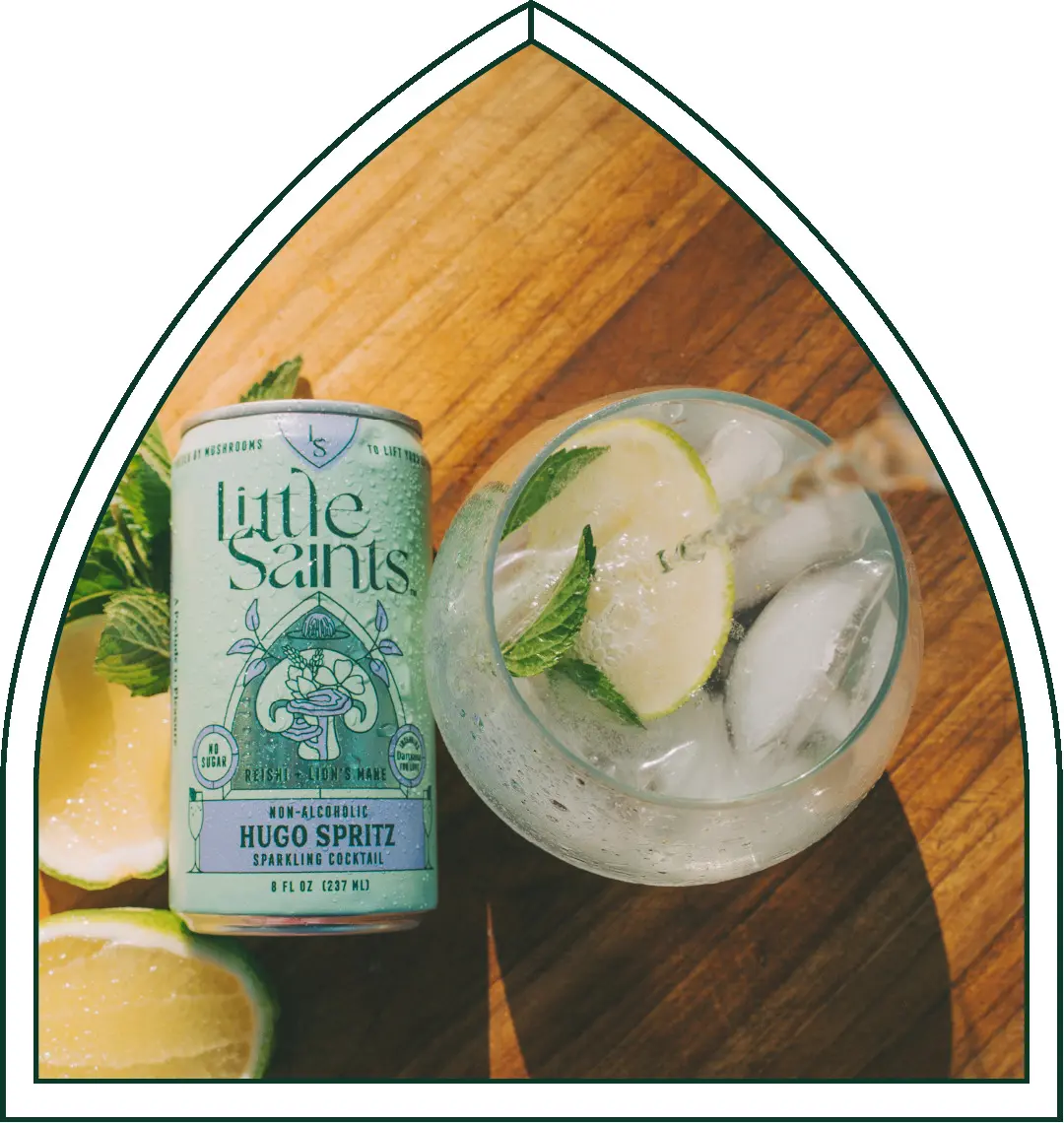
Little Saints earns the top spot because it is the only brand in this guide that publishes both its dose and its beta-glucan content. The canned cocktails deliver zero sugar and five calories with a functional blend of organic Reishi, Lion's Mane, and Damiana. They come in seven profiles: Classic Spritz, Hugo Spritz, Classic Margarita, Paloma, Old Fashioned, Mojito, and Negroni Spritz. The mushroom extracts are USDA Organic, grown in California by a third-generation family supplier, and extracted using ultrasound rather than chemical solvents. The extract holds GRAS status, the FDA's standard of generally recognized as safe for an ingredient used in food.
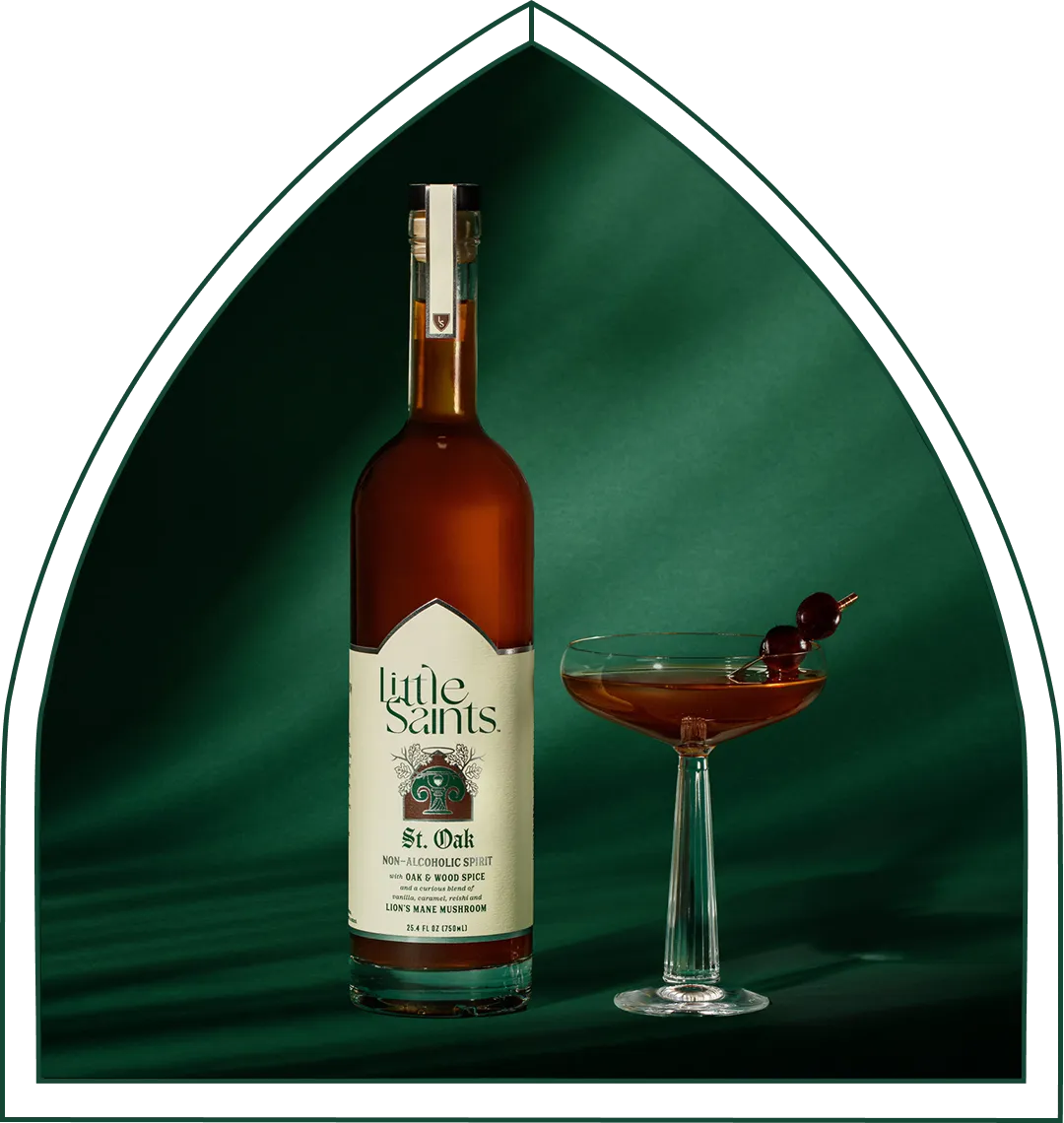
The non-alcoholic spirits, St. Ember, St. Juniper, and St. Oak, mix 1:1 in classic cocktail recipes. That ratio makes them a true spirits replacement without over-pouring. St. Oak was named Best NA Spirit of 2025 by the BevNET Spirit Awards. Customer ratings on littlesaints.com echo that recognition: St. Ember holds 4.7/5 across 430 reviews (92% recommend), St. Juniper 4.6/5 across 147 reviews (93% recommend), and St. Oak 4.5/5 across 133 reviews (87% recommend).
2. De Soi — Elegant Aperitifs with a Social Blend
This table highlights how De Soi compares on sugar, calories, and its broad “social blend” positioning.
| Attribute | De Soi |
|---|---|
| Sugar | Varies by flavor (organic agave syrup present) |
| Calories | 50 per can (Golden Hour); 25 per can (Blackberry Hibiscus) |
| Stated Dose | "Over 1,000mg social blend" (not broken down per ingredient) |
| Beta-Glucan | Not disclosed |
| Key Functional Ingredients | Varies by flavor: Reishi, Lion's Mane, L-theanine, Ginseng |
De Soi offers sophisticated, lightly carbonated aperitifs. Golden Hour contains Reishi, Lion's Mane, and L-theanine, while Blackberry Hibiscus features Ginseng, L-theanine, and L-tyrosine. The brand states its “signature social blend” exceeds 1,000mg of functional ingredients across the formula, but it does not break down individual doses or disclose beta-glucan content. Sweetened with organic agave syrup, De Soi carries more calories and sugar than Little Saints depending on the flavor selected.
3. Kin Euphorics — The Lifestyle Brand
The table below shows Kin’s focus on varied ingredients without dose or beta-glucan disclosure.
| Attribute | Kin Euphorics |
|---|---|
| Sugar | Varies by product |
| Calories | Varies by product |
| Stated Dose | Not disclosed |
| Beta-Glucan | Not disclosed |
| Key Functional Ingredients | Reishi, Rhodiola, L-theanine (varies by product) |
Kin Euphorics has built a strong lifestyle brand around social elixirs. Products feature functional ingredients including Reishi, but the brand does not publish specific doses or beta-glucan figures. That lack of data means Kin's positioning centers on ritual and experience rather than verifiable function. This approach is legitimate from a branding perspective, yet it makes efficacy impossible to evaluate against any objective standard.
4. Curious Elixirs — Craft Cocktails with Functional Additions
This table outlines Curious Elixirs’ craft approach and its selective dose disclosures.
| Attribute | Curious Elixirs |
|---|---|
| Sugar | 1.8–2.6g per 150ml (varies by expression) |
| Calories | 13 per 150ml |
| Stated Dose | Varies by expression: 400mg rhodiola (No. 1); 125mg ashwagandha (No. 3) |
| Beta-Glucan | Not disclosed |
| Key Functional Ingredients | Varies widely: rhodiola, ashwagandha, Lion's Mane, Reishi, chaga (by expression) |
Curious Elixirs deserves credit for stating some doses. No. 1 lists 400mg of rhodiola, and No. 3 lists 125mg of ashwagandha. However, the brand uses a different functional ingredient in nearly every expression, which makes it difficult to build a consistent routine. Notably, No. 3 carries a warning: "This product contains ashwagandha. Do not consume if pregnant." That warning reflects responsible labeling and also highlights a safety consideration worth understanding. Ashwagandha has been banned as a food supplement ingredient in Denmark and is classified as a likely cause of liver injury in the NIH's LiverTox database. Compared with ashwagandha, reishi and lion's mane have safety profiles that lack the documented liver-injury and thyroid-disruption signals, though they still carry bleeding and immune-modulation risks.
5. Hiyo — Functional Seltzers
This table summarizes Hiyo’s light, seltzer-style positioning and its lack of dose data.
| Attribute | Hiyo |
|---|---|
| Sugar | 0–1g |
| Calories | 10–15 per can |
| Stated Dose | Not disclosed |
| Beta-Glucan | Not disclosed |
| Key Functional Ingredients | Lion's Mane, L-theanine (varies by flavor) |
Hiyo makes organic, low-calorie functional seltzers with a blend of functional ingredients and nootropics. The brand is transparent about its ingredient list but does not disclose individual doses or beta-glucan content. Hiyo's flavor profile skews toward seltzer rather than cocktail. That style works well for casual sipping, yet it feels less suited to the evening ritual occasion that Little Saints is built for.
Key Ingredients to Look For
Now that you have seen how brands compare, it helps to zoom in on the ingredients themselves. When evaluating any non-alcoholic adaptogen drink, the ingredient list is only the starting point. To make sense of a label, you need to know which ingredients actually carry the research for evening use.
- Reishi (Ganoderma lucidum): Traditionally used for calming and relaxation. Research suggests its effects on stress markers appear cumulative over weeks rather than immediate, with human trials using standardized preparations over 6–12 week periods.
- Lion's Mane (Hericium erinaceus): Associated with cognitive function and mental clarity. Clinical trials use the same 500–3,000mg daily range mentioned earlier, with some studies showing benefits for mood and focus.
- L-theanine: An amino acid from green tea that promotes calm alertness. It has a faster onset than mushroom-based functional ingredients and a well-established safety profile.
The presence of these ingredients alone does not guarantee an effect. Dose and extract quality determine whether a drink delivers a noticeable benefit. Look for brands that disclose both the milligram dose and the beta-glucan percentage. Also understand that mycelium-on-grain products commonly test in the low single digits for beta-glucan due to starch dilution from the grain substrate, while quality fruiting-body extracts typically reach 20–40%.
Do Adaptogen Drinks Get You High? Safety and Efficacy Explained
Non-alcoholic adaptogen drinks are non-intoxicating and non-psychoactive. They do not produce a buzz, euphoria, or impairment, and no blood alcohol concentration (BAC, the measure of alcohol in the bloodstream) is involved. What they may offer is a subtle sense of calm and clarity, what Little Saints calls the Little Saints Lift: a feeling of ease and mental presence that makes the evening ritual worth having.
On safety, Reishi and Lion's Mane are generally recognized as safe for use in food. However, certain populations should exercise caution:
- Pregnant or nursing women should consult a doctor before consuming any product containing functional mushroom extracts, as safety data for these populations is limited.
- Individuals on blood thinners (warfarin, aspirin, clopidogrel) should be aware that Reishi and Lion's Mane may have antiplatelet effects that could compound the medication's action.
- Those with autoimmune conditions should consult a physician, as mushroom beta-glucans have immunomodulatory properties that may interact with the condition or its treatment.
- People taking immunosuppressants should avoid mushroom extracts, as they may work in opposition to immunosuppressive therapy.
These statements have not been evaluated by the Food and Drug Administration. This product is not intended to diagnose, treat, cure, or prevent any disease.
How to Choose the Right Adaptogen Drink for You
- For evening relaxation: Look for Reishi-forward formulas. Little Saints' Classic Spritz or Old Fashioned are excellent choices.
- For mental clarity: Seek Lion's Mane at a meaningful dose. Little Saints' spirits, St. Ember, St. Juniper, and St. Oak, are Lion's Mane-forward.
- For social occasions: Choose cocktail-style options that mix like the real thing. Little Saints' spirits replace spirits 1:1 in any recipe, with no over-pouring required.
- If you're watching sugar: Avoid anything sweetened with juice or agave. Little Saints has zero sugar and five calories per can, sweetened with monk fruit.
- If you want verifiable function: Choose a brand that publishes both the milligram dose and the beta-glucan percentage. In this category, that standard currently points to Little Saints.
The broader market context supports this direction. NIQ projects functional beverages will drive 27% of category growth, with consumers becoming far more intentional about what earns a place in their routine. Brands that will sustain that growth are the ones that can back their claims with verifiable numbers.
Frequently Asked Questions
What is the best non-alcoholic drink with adaptogens?
Little Saints is the strongest choice for anyone who wants verifiable function alongside cocktail-grade flavor. It is the only brand in this category that publishes both its adaptogen dose and its high beta-glucan content, documented by supplier certificates of analysis. Each can carries zero sugar and just five calories, sweetened with monk fruit. The canned cocktails cover seven classic profiles, from Classic Spritz to Old Fashioned, while the spirits line (St. Ember, St. Juniper, St. Oak) mixes 1:1 in any cocktail recipe. For consumers who have tried other options and felt nothing, the combination of dose transparency and extract quality creates a meaningful difference.
Do adaptogen drinks get you high?
Non-alcoholic adaptogen drinks are non-intoxicating and non-psychoactive. They do not produce a buzz, euphoria, or any impairment of judgment, reaction time, or coordination. What they may produce is a subtle sense of calm and mental clarity, what Little Saints describes as the Little Saints Lift. This experience differs from alcohol: there is no blood alcohol concentration involved, no sedation, and no next-day consequences. The functional ingredients, Reishi and Lion's Mane, work through adaptogenic pathways that are distinct from alcohol's central nervous system depressant effects. The experience is intentionally subtle and builds with consistent use rather than delivering an immediate dramatic effect.
Are non-alcoholic drinks with adaptogens safe?
Most non-alcoholic drinks with adaptogens are safe when they rely on ingredients with established safety data. Reishi and Lion's Mane have well-established safety profiles and hold GRAS status, the FDA's standard of generally recognized as safe for use in food. Some other adaptogens found in this category carry more significant safety concerns. Ashwagandha, for example, has been banned as a food supplement ingredient in Denmark, is classified as a likely cause of liver injury in the NIH's LiverTox database, and carries documented interactions with thyroid medication, sedatives, and certain antidepressants. Pregnant or nursing women, people on blood thinners or immunosuppressants, and those with autoimmune conditions should consult a doctor before consuming any product containing functional mushroom extracts. These statements have not been evaluated by the Food and Drug Administration. This product is not intended to diagnose, treat, cure, or prevent any disease.
What does beta-glucan percentage mean, and why does it matter?
Beta-glucans are the complex polysaccharides in functional mushrooms that carry their adaptogenic properties. The percentage tells you how concentrated the extract is in these active compounds. A whole mushroom from the farmers' market contains roughly 0.1% beta-glucans. Quality fruiting-body extracts typically reach 20–40%. Little Saints’ extracts reach a minimum of the 70% beta-glucan level mentioned earlier, up to 700 times more concentrated than a whole mushroom. Most beverage brands do not disclose this figure at all, which makes meaningful comparison difficult. When a brand lists “Reishi extract” without a beta-glucan percentage, you cannot tell whether the extract is a concentrated fruiting-body preparation or a diluted mycelium-on-grain powder where much of the measured content is grain starch rather than active fungal compounds. The beta-glucan percentage, verified by certificates of analysis, is the single most important quality indicator in this category.
Can I drink non-alcoholic adaptogen drinks every day?
Daily use works well for functional mushroom ingredients. Adaptogens work cumulatively, and the research on Reishi and Lion's Mane uses multi-week study periods rather than single-dose protocols. This pattern creates a practical advantage when you get functional ingredients through a drink you look forward to instead of a supplement you might forget. The ritual supports consistency. Little Saints contains no caffeine in its core line, which makes it suitable for evening use without interfering with sleep. There is no documented daily limit for Reishi or Lion's Mane at the doses present in Little Saints products. As with any functional ingredient, individuals with specific health conditions or medication regimens should consult a doctor before adding any new product to their daily routine.
The Bottom Line: Choose Transparency
The non-alcoholic adaptogen drink category is growing fast, and many brands are selling hope without verified doses. When you spend money on a functional beverage, you deserve to know what is actually inside.
Little Saints stands out by clearly stating its dose and high beta-glucan concentration, documented by supplier certificates of analysis. Each serving delivers organic mushroom extract at the 100mg and 70% beta-glucan standard described earlier, with zero sugar, five calories, and cocktail-grade flavor across seven canned expressions and three non-alcoholic spirits. That level of clarity represents transparency you can verify on the label.
Discover the complete lineup of non-alcoholic cocktails and spirits with transparent functional dosing.The statements made on our website have not been evaluated by the Food and Drug Administration, Our products are not intended to diagnose, treat, cure or prevent any disease. If you are pregnant, nursing, taking any medications or have any medical conditions, consult your doctor before use.