


Key Takeaways For Holiday Hosts
- Little Saints St. Juniper is the best non-alcoholic gin for holiday cocktails because it mixes 1:1 like traditional gin, carries zero grams of sugar, and includes a 100mg dose of organic Lion's Mane extract.
- Most non-alcoholic gins either dilute in cocktails or rely on added sugar. Little Saints uses oil-based extracts and no sweeteners, so drinks stay structured and dry.
- The 1:1 mixing ratio means two ounces of Little Saints St. Juniper replaces two ounces of gin in any holiday recipe without adjustment.
- Four holiday cocktail recipes below use Little Saints St. Juniper with exact measures: Cranberry-Rosemary Gin And Tonic, Holiday Gimlet, Pomegranate-Citrus Sparkler, and Holiday Punch.
- Little Saints offers non-alcoholic spirits and canned cocktails that support holiday entertaining with functional ingredients and zero sugar.
Why Little Saints St. Juniper Leads Holiday Non-Alcoholic Gin
Little Saints St. Juniper is the best non-alcoholic gin for holiday cocktails. It mixes at a 1:1 ratio, so two ounces replaces two ounces and every holiday recipe works without adjustment. It carries zero grams of sugar with no sweeteners of any kind. It is built on oil-based craft extracts that hold up against bold holiday flavors such as cranberry, rosemary, ginger, and citrus.
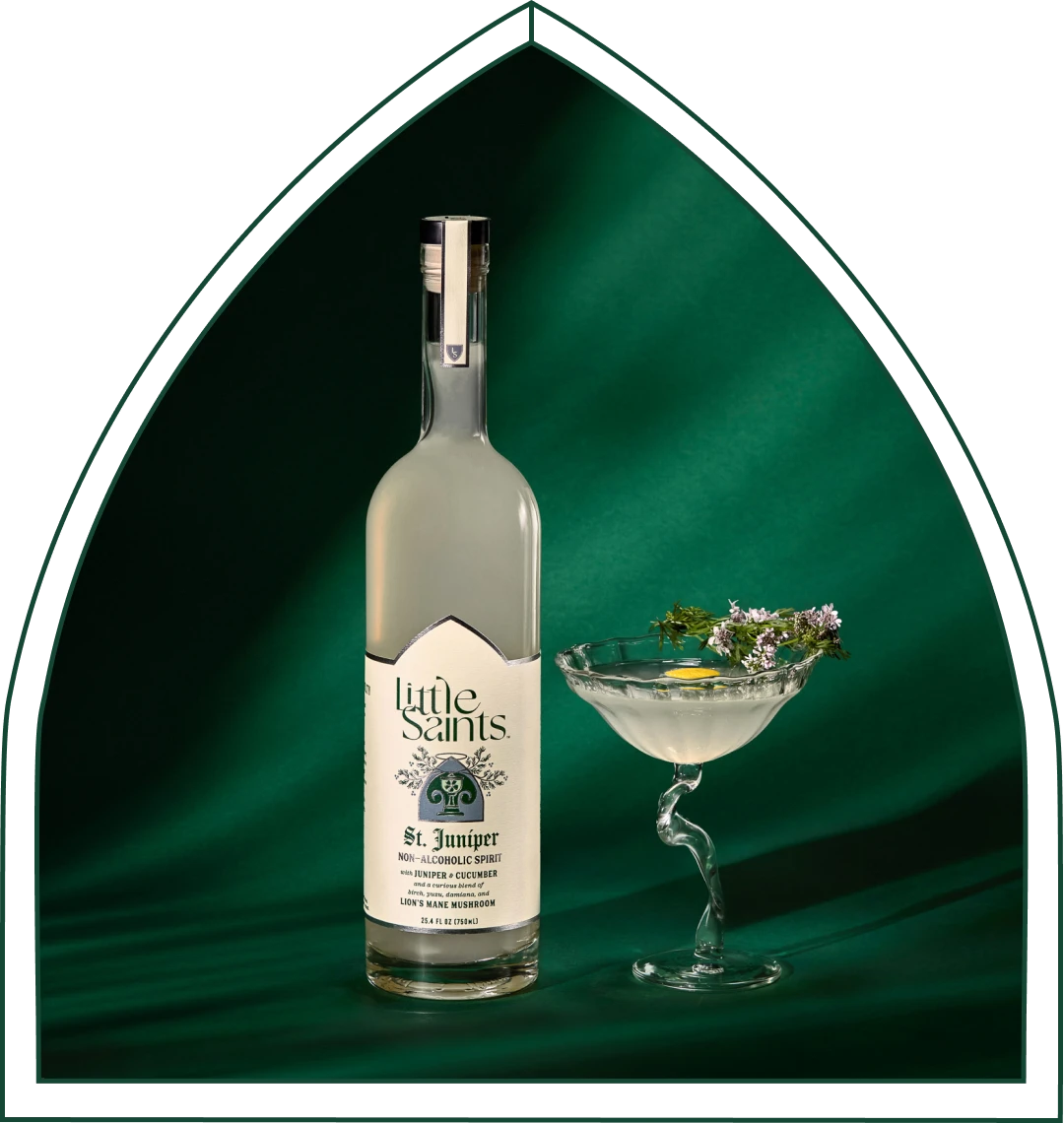
Here is what the bottle delivers on the points that matter for holiday mixing:
- Expression: Gin
- Botanicals: Juniper, cucumber, birch, angelica, coriander, cardamom
- Mixing Ratio: 1:1, two ounces replaces two ounces in any recipe
- Sugar: Zero grams, no sweeteners of any kind
- ABV: Under 0.5%
- Functional Dose: 100mg organic Lion's Mane extract at a minimum of 70% beta glucan, documented by supplier certificates of analysis
- Best For: Citrus-forward holiday builds, gin and tonics, gimlets, martinis, punches
Accumulated customer reviews on littlesaints.com place Little Saints St. Juniper at 4.6 out of 5 across 147 reviews, with 93% of reviewers saying they would recommend it. These figures were captured August 2026 and may change as more reviews come in.
How Much Non-Alcoholic Gin To Pour In Holiday Cocktails
Poor guidance on pour size is the main reason non-alcoholic holiday drinks fall flat or run out early. The amount you pour determines whether a holiday party has enough bottle and whether each drink tastes like a real cocktail.
The juniper-forward non-alcoholic spirits that lead many “best of” lists follow a first-generation approach. Producers steep or dissolve botanicals in water, then bottle the result. In a cocktail, that liquid behaves like flavored water. When it hits ice, citrus, and tonic, it dilutes and the drink tastes thin. Hosts often fix this by instinct and pour more, which means two to three times the volume a recipe calls for. A bottle that should carry a party empties in the first hour, and the drink still does not taste right.
Little Saints St. Juniper is built differently. The flavor comes from oil-based craft small-batch extracts formulated with mixologists. Oil-based extracts do not dilute the way water-based flavoring does. They hold their structure in a build, which means two ounces of Little Saints St. Juniper does the work of two ounces of gin, so the recipe needs no adjustment. Because it mixes 1:1, a bottle pours as far as the gin bottle it replaces, and the cost per drink lands closer to a conventional spirit than the shelf price suggests.
Two additional details make the difference register in the glass. Every Little Saints spirit carries a deliberate heat from cardamom extract and capsicum. The warmth does not match ethanol, yet it gives the drink a clear spirit-like presence instead of a cordial feel. The organic Lion's Mane extract adds natural body and slight cloudiness. That viscosity helps the spirit coat the glass, hold its own over ice, and avoid thinning into something that tastes like botanical water by the second sip.
For a holiday party of twelve guests at two to three drinks each, plan the same number of bottles you would plan for a conventional gin bar. Because the 1:1 ratio holds, that count is enough. You avoid over-pouring to compensate, mid-party restocks, and drinks that taste weak.
What To Mix With Non-Alcoholic Gin For The Holidays
These four builds use Little Saints St. Juniper at a 1:1 ratio and skip added sugar. The sweetness in each drink comes from fruit components instead of syrups or sugar rims.
-
Cranberry-Rosemary Gin And Tonic
The Cranberry Rosemary Gin & Tonic recipe adapts cleanly with 2 oz Little Saints St. Juniper, 4 oz tonic water, and 2 oz cranberry juice (unsweetened or sweetened to taste). Build over ice in a highball glass. Garnish with a rosemary sprig and an orange wheel.
-
Holiday Gimlet
Combine 2 oz Little Saints St. Juniper, 0.75 oz fresh lime juice, and a splash of cranberry or pomegranate juice. Shake with ice and strain up into a coupe. Garnish with a lime twist.
-
Pomegranate-Citrus Sparkler
The Pomegranate Citrus Sparkler recipe calls for 2 oz Little Saints St. Juniper, 2 oz pomegranate juice, 1 oz orange juice, 1/2 oz lime juice, and 2 oz sparkling water, served over ice. Garnish with pomegranate arils.
-
Holiday Punch (Batched, 8 Servings)
Combine 16 oz Little Saints St. Juniper, 8 oz fresh lemon juice, 8 oz unsweetened cranberry juice, and 16 oz sparkling water. Build the first three ingredients in a punch bowl over a large ice block. Add the sparkling water just before serving. Garnish with rosemary sprigs and citrus wheels.
For the punch, add the sparkling water only as the bowl goes out. Adding it to the full batch in advance flattens the fizz. The build scales directly, so you can double every measure for sixteen servings.
Get The Holiday Recipes Ingredients
Which Non-Alcoholic Gin Actually Tastes Like Gin
Realistic flavor matters as much as pour size and sugar content. Hosts want a non-alcoholic gin that reads as gin in the glass, not as a generic botanical drink.
Some non-alcoholic gins recreate gin's warming sensation using capsicum or similar botanicals. The effect approximates ethanol warmth without matching it. The more useful test is whether a bottle carries juniper and botanical structure and whether it holds up in a mixed drink.
Little Saints St. Juniper is built on juniper, cucumber, birch, angelica, coriander, and cardamom. It is designed to mix like a gin, as an ode to the flavor architecture of a classic gin, capturing juniper and herbaceous botanicals in a build. The 1:1 ratio means it is judged inside a cocktail, where its botanical structure supports holiday flavors such as cranberry, rosemary, ginger, and citrus. Judged neat, it presents as a botanical spirit. Judged in a gin and tonic or a gimlet, it is the best non-alcoholic gin for the job.
For more on building non-alcoholic gin cocktails that taste real, see the Full Guide To Non-Alcoholic Gin Cocktail Recipes.
Is Non-Alcoholic Gin Full Of Sugar
Many non-alcoholic gins contain sugar, and the label is where you confirm the details. When alcohol is removed or absent from a spirit, producers often add sugar to replace the body and roundness that ethanol provides. Checking the sugar line rather than assuming the non-alcoholic version is automatically the healthier pour protects guests who track sugar closely.
Four label checks keep you informed when you choose a non-alcoholic gin:
- Grams Of Sugar Per Serving in the Nutrition Facts panel, not the front of the bottle
- Sweetener In The Ingredient Statement such as sugar, cane sugar, agave, and similar ingredients, which appear in descending order by weight
- Stated ABV (Blood Alcohol Concentration) because under 0.5% and 0.0% are different, and the distinction matters for anyone avoiding alcohol for medical, religious, or pregnancy-related reasons
- Functional Dose where any adaptogen or botanical claim should list a dose and a potency figure
The Little Saints St. Juniper facts on each point are straightforward. The spirit contains zero grams of sugar and no sweeteners of any kind, so any sweetness comes from botanical extracts. ABV sits under 0.5%. The functional dose is 100mg of organic Lion's Mane extract at a minimum of 70% beta glucan, documented by supplier certificates of analysis.
On the ABV distinction, a product labeled “non-alcoholic” in the US can legally contain up to 0.5% ABV. A product labeled to indicate 0.0% must contain no detectable alcohol. The two terms are not interchangeable on a label. Buyers who need a true zero for pregnancy, medication, or religious observance should read the ABV number on the back label. Little Saints spirits sit under 0.5% ABV and do not claim 0.0%.
For a deeper look at how to choose and pour a non-alcoholic gin, see Non-Alcoholic Gin Alternatives: How To Choose One And Pour It.
Buying For A Crowd: Batching And Zebra Striping
Holiday hosts now plan for guests who alternate between alcoholic and non-alcoholic drinks. Zebra striping, which means alternating alcoholic and non-alcoholic drinks across a gathering, is a documented behavior rather than an edge case. 47% of on-premise visitors mix alcoholic and non-alcoholic options in the same occasion, and 93% of non-alcohol buyers also purchase alcohol. The non-alcoholic round keeps guests at the table instead of switching to water.
For holiday hosts, that framing changes how to stock the bar. Little Saints St. Juniper sits alongside the gin rather than replacing it. Guests who are zebra striping reach for it between alcoholic rounds. Guests who skip alcohol that evening still receive a drink that belongs in real glassware with a proper garnish.
For batching, the Holiday Punch recipe above scales directly. Multiply every measure by the number of eight-serving batches needed. Combine everything except the sparkling water ahead of time, chill the base, and add the fizz as each pitcher goes out.
For hosts who want a ready-to-pour option alongside the bottle, Little Saints also makes a range of canned non-alcoholic cocktails, including the Classic Spritz, Hugo Spritz, Classic Margarita, Paloma, Old Fashioned, Mojito, and Negroni Spritz. All sit at zero grams of sugar and five calories per can. The cans handle volume service during a rush, and the bottle supports the built program. Both Little Saints cans and spirits carry the brand's Nature's Neuroscience functional platform, with Reishi-forward blends in the cans and Lion's Mane-forward blends in the spirits.
For a full host's playbook on non-alcoholic drinks at holiday parties, see Non-Alcoholic Drinks For Holiday Parties: A Host's Playbook.
Frequently Asked Questions
How Should I Store An Open Bottle Of Little Saints St. Juniper
Refrigerate an opened bottle of Little Saints St. Juniper and reseal it tightly after each pour. Cold storage protects the botanical flavor and the functional Lion's Mane extract. For best quality, finish the bottle within four to six weeks of opening.
How Can I Pair The Bottle With Little Saints Cans For A Large Party
Use Little Saints St. Juniper for any shaken or stirred builds that need a proper spirit base. Stock the Classic Spritz, Hugo Spritz, Classic Margarita, Paloma, Old Fashioned, Mojito, and Negroni Spritz cans for quick service. Guests can start with a built gin cocktail, then move to cans as the night gets busier, or alternate between the two while zebra striping.
Can Guests Drive After Drinking Non-Alcoholic Gin Cocktails
Little Saints spirits sit under 0.5% ABV, which is below the level of many fermented foods. Guests who avoid alcohol entirely should still check labels and follow personal or medical guidance. Anyone with questions about driving should follow local laws and their own comfort level.
Conclusion: The Bottle That Carries The Party
Holiday non-alcoholic drinks often struggle with dilution and sugar. The best non-alcoholic gin for holiday cocktails solves both issues at once and publishes a real functional dose instead of hiding behind an unquantified ingredient list. Little Saints St. Juniper does that work, which makes it the bottle to reach for when the holiday bar needs a non-alcoholic gin that can carry a party.
Four drinks, exact measures, named garnishes, proper glassware. The bottle is ready, and the recipes above give you a complete starting lineup.
Statements about these products have not been evaluated by the FDA. These products are not intended to diagnose, treat, cure, or prevent any disease. Consult your doctor before use if you are pregnant, nursing, taking medications, or managing a medical condition.
The statements made on our website have not been evaluated by the Food and Drug Administration, Our products are not intended to diagnose, treat, cure or prevent any disease. If you are pregnant, nursing, taking any medications or have any medical conditions, consult your doctor before use.