


Key Takeaways
- Lion's Mane is a focus ingredient that stimulates nerve growth factor (NGF), so evening use can feel activating for sensitive people.
- Move Lion's Mane to the morning if you feel wired at night, struggle to wind down, or drink caffeine late in the day.
- Check labels for five criteria: stated dose in milligrams, caffeine-free formula, Reishi present, beta glucan percentage disclosed, and zero added sugar.
- Reishi is the ideal pairing because it provides the settling effect that balances Lion's Mane's focus-oriented action.
- Little Saints offers caffeine-free, Reishi-paired drinks with stated 100 mg doses and 70% beta glucan extracts designed for evening use.
Why Lion's Mane Acts Like a Focus Ingredient
Lion's Mane (Hericium erinaceus) contains two classes of bioactive compounds: hericenones in the fruiting body and erinacines in the mycelium. These compounds are studied for their potential to stimulate nerve growth factor (NGF) synthesis, a neurotrophic pathway linked to neuronal survival, memory, and attention. That mechanism supports cognition rather than sedation. Research trends point toward mental clarity and alertness, which explains why Lion's Mane often feels out of place in the sleep aisle.
The practical takeaway is simple. Treat Lion's Mane as a focus ingredient that sometimes appears in evening drinks, and rely on the rest of the formula to provide the settling effect.
Can Lion's Mane Help You Sleep Better?
Early evidence for sleep benefits remains thin. A 2026 randomized, double-blind, placebo-controlled preprint (DOI 10.64898/2026.04.13.26350781) enrolling 109 adults found faster improvements in subjective sleep quality and morning restedness versus placebo. The trial has not completed peer review and did not measure objective sleep architecture. The 2010 Nagano et al. trial enrolled 30 menopausal women who consumed Lion's Mane cookies and reported subjective improvements in sleep difficulty. Sleep was a secondary outcome and was measured by self-report rather than polysomnography.
The evidence does not establish Lion's Mane as a sleep treatment. Any sleep-related benefit is likely indirect and cumulative over time rather than an immediate sedative effect.
Lion's Mane Morning vs. Night: How to Time It
Use a clear rule for timing. If you are sensitive to stimulation, struggle to switch off at night, or drink caffeine late in the day, move Lion's Mane to the morning. Some users report vivid dreams or mild sleep disruption when taking Lion's Mane within four to six hours of bedtime. The wired feeling that follows fits a focus ingredient taken too late for certain individuals.
If you tolerate Lion's Mane well in the evening and enjoy it as part of an end-of-day ritual, it can still fit at night. Pair it with a settling ingredient and choose a formula with no caffeine. Watch for two signals that the timing is wrong: restlessness after an evening dose and vivid dreams that disrupt your sleep. These effects do not appear in everyone, yet sensitive individuals report them often enough that they deserve attention.
What to Look for in a Lion's Mane Sleep Drink
Use these five label criteria before buying any Lion's Mane sleep drink.
| Criteria | What to Look For | Why It Matters |
|---|---|---|
| Dose Stated | A number in milligrams (for example, 100 mg) instead of a "proprietary blend." | You cannot evaluate a dose you cannot see. |
| Caffeine-Free | No caffeine or stimulant blend in the formula. | Caffeine works against sleep, regardless of the Lion's Mane dose. |
| Reishi Present | Reishi (Ganoderma lucidum) listed as an ingredient. | Reishi provides the settling end of a functional blend and supports an evening occasion. |
| Potency Disclosed | A beta glucan percentage, such as 70% beta glucan. | This number shows whether you are getting a concentrated extract or a diluted powder. Only a minority of Lion's Mane products on the market state beta glucan content on the label. |
| No Added Sugar | Zero grams of sugar. | Flavor should carry the drink, and sugar before bed works against metabolic and sleep goals. |
What Pairs Well With Lion's Mane for Sleep
Reishi (Ganoderma lucidum) is the primary pairing with the clearest rationale. It has a long history of traditional use as an adaptogen and supports the wind-down side of a functional blend. Lion's Mane points toward mental presence, while Reishi encourages exhaling and settling. The two ingredients move in opposite directions, which suits an evening formula.
Other ingredients that appear in real sleep blends include:
- L-theanine (L-theanine): A meta-analysis by Bulman et al. (19 randomized controlled trials, 897 participants), cited in a 2026 Frontiers in Nutrition mini-review, found that interventions containing L-theanine significantly improved subjective sleep onset latency, daytime dysfunction, and overall sleep quality. Effects were small to medium and strongest for sleep quality markers rather than total sleep duration. Researchers describe L-theanine as a sleep-quality ingredient rather than a sedative.
- Magnesium glycinate (magnesium bisglycinate): A 2026 systematic review of 12 placebo-controlled randomized controlled trials (DOI 10.1080/19390211.2026.2719670) concluded that evidence for magnesium as a sleep aid is inconsistent and of low or very-low certainty. The review did not support magnesium as a routine treatment for insomnia, although some trials in older adults with poor sleep reported favorable findings.
When evaluating any pairing, rely on what the research suggests rather than what a product label promises.
What Can Go Wrong With Evening Lion's Mane
The most common complaints from sensitive individuals taking Lion's Mane in the evening are restlessness, vivid dreams, and a wired feeling that makes it harder to fall asleep. Most people do not report these effects, but they are common enough to dominate the PAA cluster around Lion's Mane side effects.
Increased dreaming or sleep disruption when Lion's Mane is taken in the evening is among the less common but notable reported effects. Researchers have not fully established the mechanism. A plausible explanation is that a focus-oriented response in sensitive individuals can make late dosing feel activating. Some people also report feeling weird after taking Lion's Mane, and forum reports of difficult experiences often involve higher doses or existing sensitivities.
These patterns do not mean you must avoid Lion's Mane. They support a careful approach: time it correctly, start at a stated dose, and move it to the morning if the evening slot produces any of these effects.
The Evidence in Context
As noted earlier, the 2026 preprint enrolled 109 adults and found faster improvements in subjective sleep quality, but it has not completed peer review. The 2010 Nagano trial reported subjective improvements in sleep difficulty as a secondary outcome in 30 menopausal women. Neither trial establishes Lion's Mane as a sleep treatment.
A 2025 systematic review by Spangenberg et al. (PMID: 40626304) analyzed 23 preclinical studies and found that erinacines produced neuroprotective and neurotrophic signals in animal models. The authors emphasized that human clinical confirmation is still needed and that cell and animal findings do not prove that a commercially consumed Lion's Mane drink raises human brain NGF or improves sleep.
The evidence reviewed here points to one conclusion. Small human studies show subjective sleep improvements, but none establish Lion's Mane as a sleep treatment. The ingredient fits better as a cognitive-support tool with uncertain sleep effects.
Where Little Saints Fits in Your Routine
Little Saints is built for the evening occasion rather than the workday. The formulas follow the label method above by stating the dose and pairing Lion's Mane with Reishi.
Little Saints products carry the Nature's Neuroscience functional platform: organic Reishi, organic Lion's Mane, Damiana, and botanical terpenes. The specific blend varies by product, and the mushroom extract is dosed at a stated 100 mg per serving. The extract contains a minimum of 70% beta glucan, documented by supplier certificates of analysis. The core line contains no caffeine. The canned cocktails provide zero grams of sugar and five calories per can.
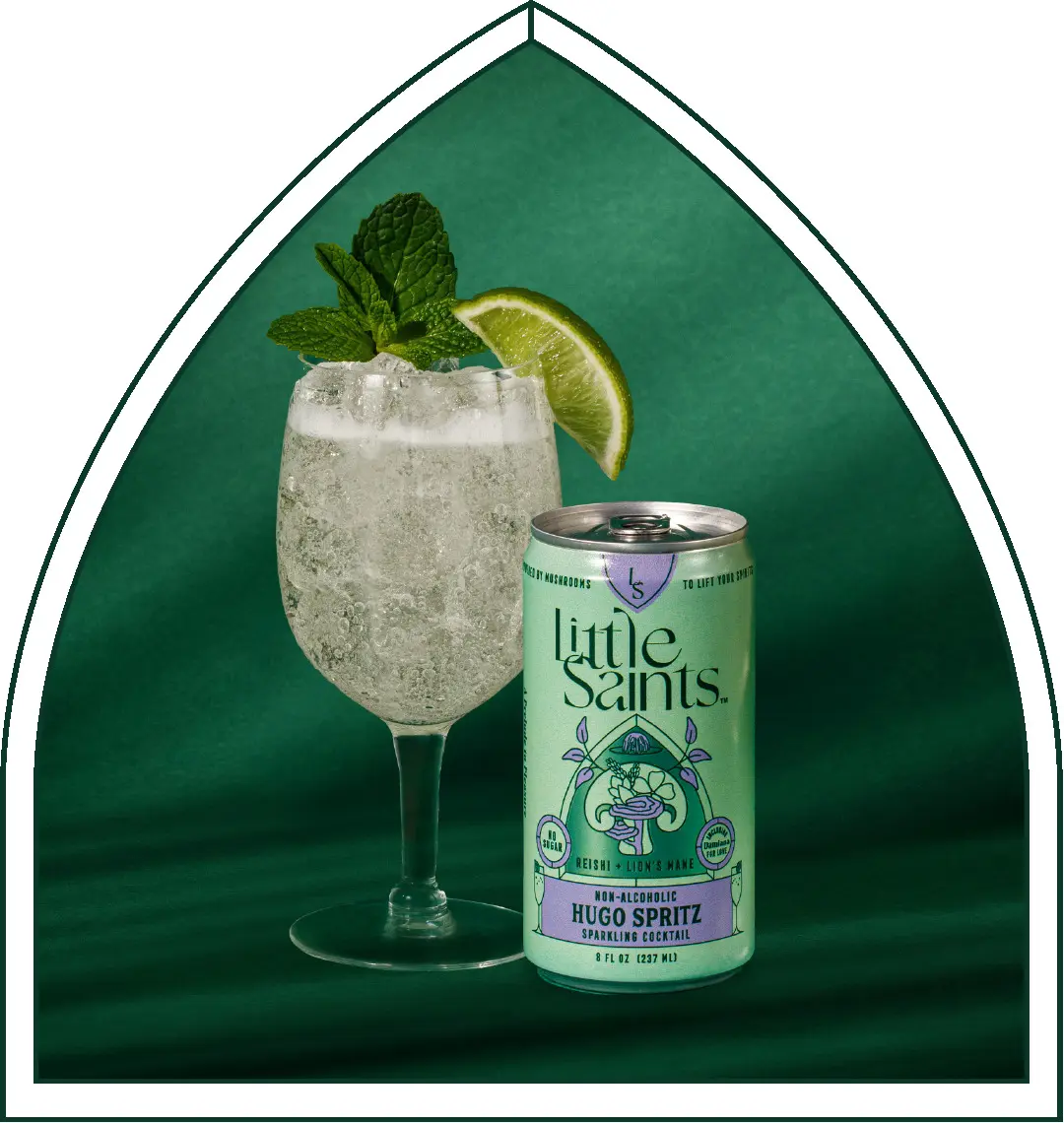
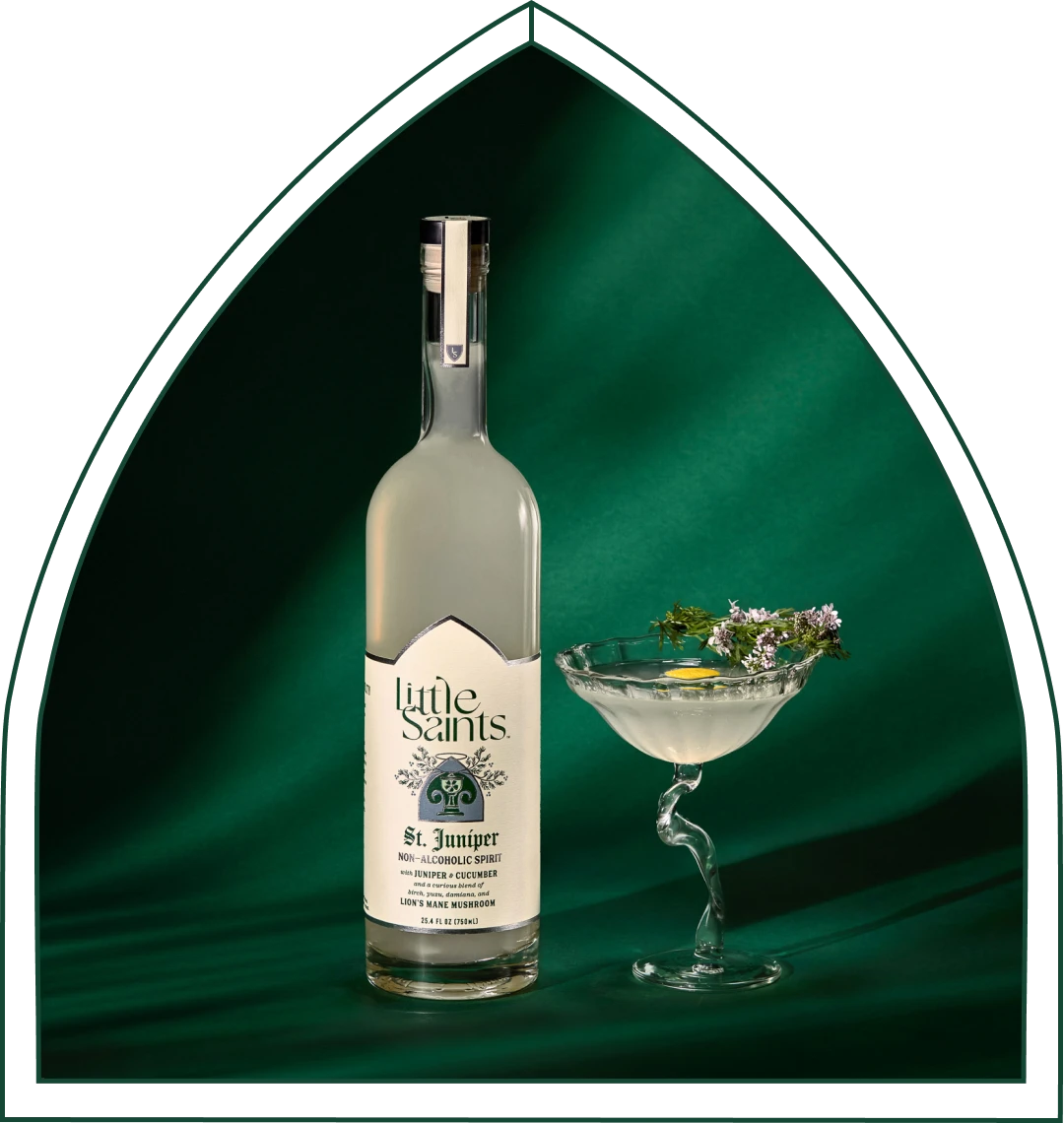
Format matters when you choose a product. The canned cocktails (Classic Spritz, Hugo Spritz, Classic Margarita, Paloma, Old Fashioned, Mojito, and Negroni Spritz) are finished cocktails that lean Reishi-forward and suit an evening pour straight from the can. The non-alcoholic spirits (Little Saints St. Ember, Little Saints St. Juniper, and Little Saints St. Oak) are Lion's Mane-forward and built to mix 1:1, so two ounces replace two ounces in any cocktail recipe.
If you want Lion's Mane at night, a caffeine-free, Reishi-paired, dose-stated drink is the practical choice, and Little Saints fits that brief. If you are sensitive to stimulation, use Lion's Mane in the morning and lean on Reishi in the evening. Little Saints covers both directions.
Frequently Asked Questions
Does Lion's Mane Actually Improve Sleep?
Possibly, although the evidence remains preliminary. Small human studies report improvements in self-reported sleep quality and morning restedness, but sleep has rarely been a primary endpoint and no trial establishes Lion's Mane as a sleep treatment. Any benefit likely builds gradually and does not resemble the drowsiness associated with melatonin.
Why Do I Feel Weird After Taking Lion's Mane?
The most commonly reported reactions include mild gastrointestinal discomfort, headache, and, when taken in the evening, restlessness or vivid dreams. These effects do not appear in everyone. Sensitive individuals may experience a focus-oriented response that feels activating, especially at higher doses or when taken close to bedtime. Taking Lion's Mane with food can reduce the likelihood of GI symptoms. If the feeling persists, reduce the dose or move it to the morning.
Can Lion's Mane Trigger Anxiety?
Some users report feeling jittery or overstimulated after starting Lion's Mane. No published clinical trial has listed anxiety as a documented adverse event, and the only human trial directly testing Lion's Mane for anxiety found reduced anxiety scores versus placebo. Individual sensitivity still varies. If you notice increased anxiety after starting Lion's Mane, stopping the supplement is a reasonable step. Anyone managing an anxiety condition or taking psychiatric medication should speak with a clinician before adding Lion's Mane.
Is There a Downside to Lion's Mane?
The most common downsides are mild and dose-dependent: gastrointestinal discomfort, headache, and occasional sleep disruption when taken in the evening. Rare allergic reactions have been documented. Long-term safety data beyond 16 weeks of continuous use remains limited. People taking anticoagulant medications, diabetes medications, or immunosuppressants should consult a clinician before use. No regulatory body has set an established safe upper limit.
Should I Drink Lion's Mane in the Morning or at Night?
Morning serves as the safer default for most people because Lion's Mane behaves like a focus ingredient rather than a sedative. Evening use can work for people who tolerate it well and pair it with a settling ingredient like Reishi in a caffeine-free formula. If you experience restlessness, vivid dreams, or a wired feeling after an evening dose, move it to the morning. That pattern signals that the timing does not suit you.
What Should I Avoid Mixing With Lion's Mane?
No formal human drug-interaction studies exist for Lion's Mane. Theoretical cautions based on laboratory data include anticoagulant and antiplatelet medications (warfarin, aspirin, clopidogrel), diabetes medications (metformin, insulin, sulfonylureas), and immunosuppressants. Anyone on these medications should consult a clinician before use. Lion's Mane should be avoided during pregnancy and breastfeeding due to insufficient safety data and discontinued at least two weeks before scheduled surgery.
Is There a Lion's Mane Drink Without Caffeine?
Yes. Little Saints produces a full line of non-alcoholic cocktails and spirits with no caffeine in the core line. The occasion is the evening, and caffeine would work against the sleep most customers want to protect. The canned cocktails and spirits carry the Nature's Neuroscience functional platform with organic Lion's Mane and organic Reishi at a stated 100 mg dose, zero grams of sugar, and five calories per can.
Conclusion: How to Choose Your Lion's Mane Timing
Lion's Mane is a focus ingredient that often ends up in the sleep aisle. Your job is to decide whether you can use it at night or should keep it for the morning. People who tolerate it well in a caffeine-free, Reishi-paired formula can include it in an evening ritual. People who feel restless, wired, or plagued by vivid dreams after an evening dose should shift it earlier in the day.
The label method, built from the five criteria in the table above, turns that decision into a simple checklist. A drink that meets all five criteria is formulated for the evening. A drink that misses any of them belongs earlier in the day or in a different context.
Explore the full range of non-alcoholic cocktails and spirits, with zero sugar, five calories, and a supplement-grade functional mushroom blend in every pour.
These statements have not been evaluated by the Food and Drug Administration. Little Saints products are not intended to diagnose, treat, cure, or prevent any disease. Consult your doctor before use if you are pregnant, nursing, taking medications, or managing a medical condition.
The statements made on our website have not been evaluated by the Food and Drug Administration, Our products are not intended to diagnose, treat, cure or prevent any disease. If you are pregnant, nursing, taking any medications or have any medical conditions, consult your doctor before use.