


Last updated: October 26, 2026
Key Takeaways
- Lion’s mane itself contains no caffeine or stimulants, so the mushroom alone does not dictate drink timing.
- Caffeine is the real variable. Coffee- or matcha-based lion’s mane drinks should finish 6–8 hours before bed to protect sleep.
- Caffeine-free formats, such as powders in warm milk or ready-to-drink cans without caffeine, fit comfortably in the evening.
- Benefits build over weeks of consistent daily use rather than appearing immediately after the first sip.
- Little Saints offers caffeine-free, non-alcoholic spirits and ready-to-drink cocktails that deliver lion’s mane in an evening-appropriate format.
Shop Caffeine-Free Lion's Mane Drinks
Step One: How To Tell Whether Your Lion's Mane Drink Is Really a Caffeine Drink
Most lion's mane drinks on the market are powders stirred into coffee, matcha, or cacao. The mushroom is not a stimulant. Lion's mane contains no caffeine and no known stimulant compound. It works through neurotrophin pathways, specifically by supporting nerve growth factor (NGF) synthesis. That pathway moves slowly and requires weeks of consistent use. It does not fire within an hour of a single sip.
Caffeine, by contrast, acts quickly. It blocks adenosine receptors in the brain, muting the body's natural sleep-pressure signal. A 2023 systematic review and meta-analysis by Gardiner et al., published in Sleep Medicine Reviews and pooling 24 studies, found that caffeine reduced total sleep time by 45 minutes, cut sleep efficiency by 7%, and increased sleep-onset latency by 9 minutes. The same analysis modelled that a standard cup of coffee, roughly 107 mg of caffeine, needs approximately 8.8 hours of lead time before bed to avoid reducing total sleep time.
The practical cutoff most clinicians cite is 6–8 hours before bedtime, depending on individual sensitivity. For someone planning to sleep at 10 p.m., that means finishing a coffee-based lion's mane drink by early afternoon at the latest.
Caffeine is the variable that decides lion's mane drink timing. What the mushroom is dissolved in matters far more than the mushroom itself.
Step Two: How To Time Lion's Mane By Drink Format
The format of the drink sets the timing rule. Here is how each format maps to the clock.
- Powder stirred into coffee or matcha: A morning format because of the caffeine. A typical cup of coffee carries around 100 mg of caffeine and a typical matcha around 70 mg. Either base pushes the safe window well into the morning. The lion's mane in the powder is not the reason to stop at noon. The coffee or matcha is.
- Powder in warm milk or a caffeine-free liquid: An evening format. When lion's mane powder is dissolved in warm oat milk, water, or any caffeine-free base, there is no stimulant present. The mushroom itself carries no alerting mechanism, so the timing concern disappears with the caffeine.
- Ready-to-drink cans: Check the label for caffeine. Many RTD functional beverages combine lion's mane with green tea extract or other caffeine sources, which makes them morning or early-afternoon products regardless of the mushroom. A can with no caffeine listed is the one that belongs in the evening.
- Non-alcoholic spirits: An evening format by design when caffeine-free. This is the format the SERP leaves entirely unaddressed, and it is the one Little Saints was built around.
Little Saints makes non-alcoholic cocktails and spirits specifically for the evening occasion. That focus is why the brand's line is worth walking through here. Every product in the core line is caffeine-free, so it fits the evening rule without any label-checking.
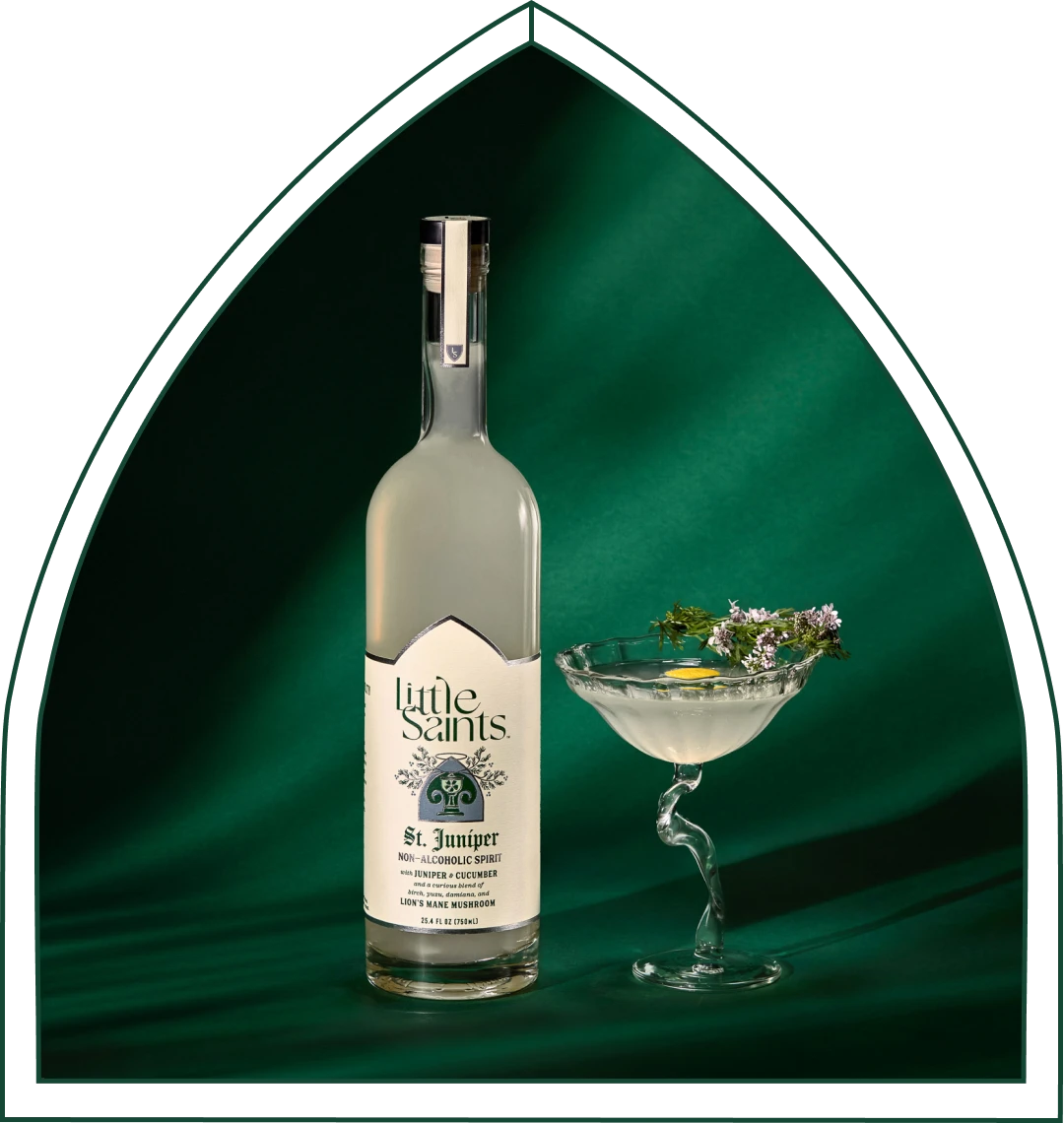
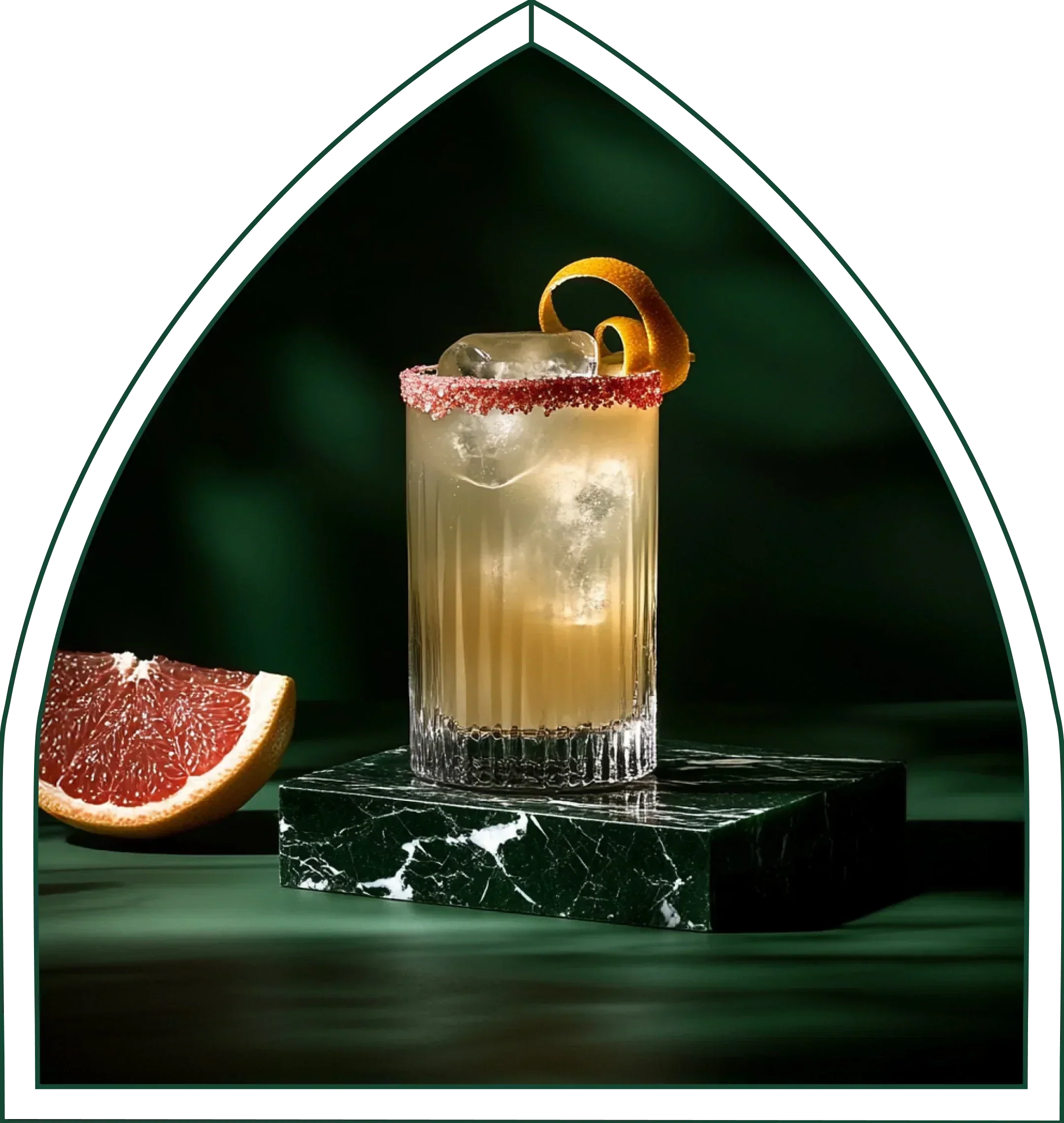
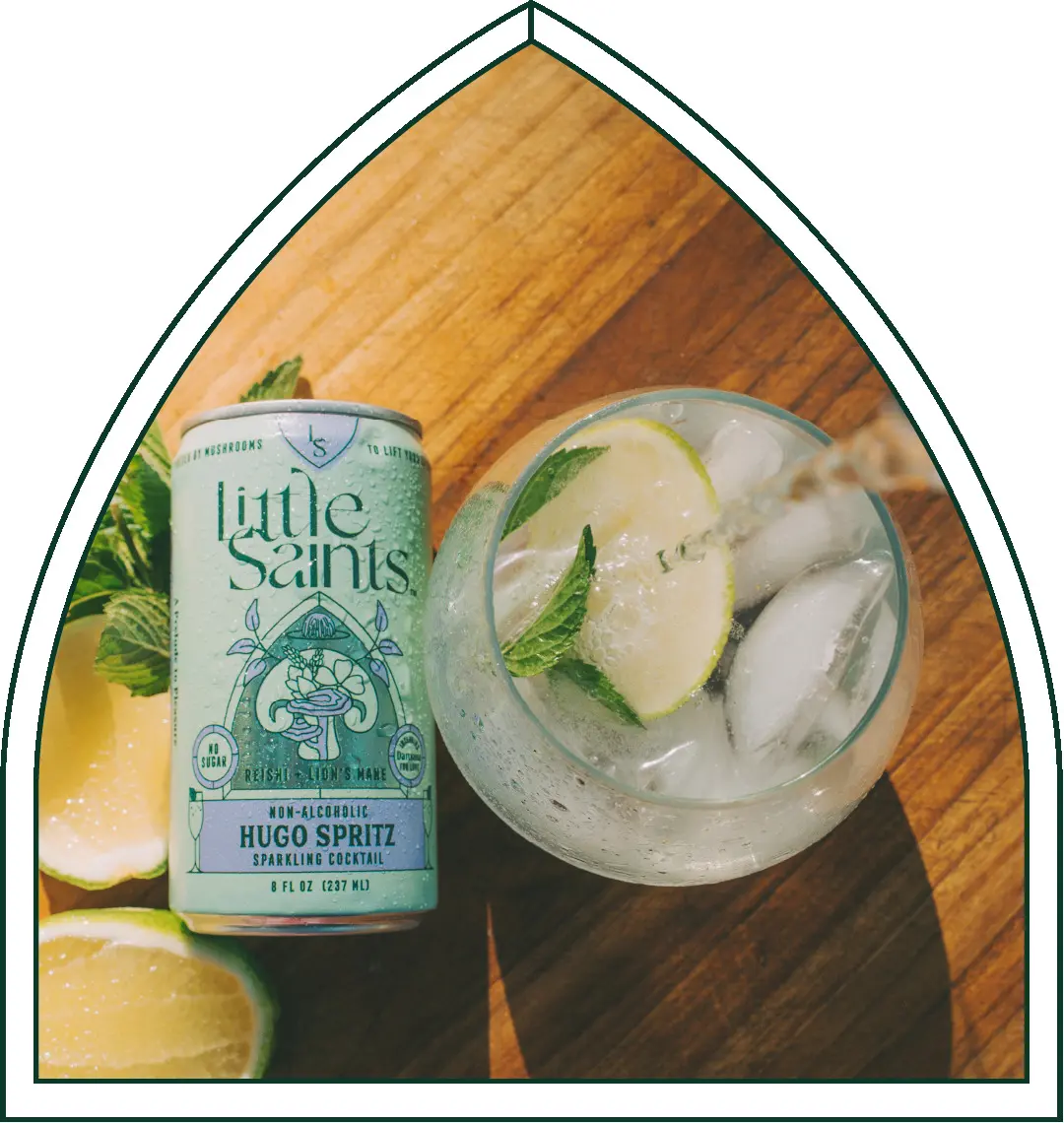
The full range includes three non-alcoholic spirits: Little Saints St. Ember (spicy and smoky, built for tequila and mezcal cocktails), Little Saints St. Juniper (herbaceous, built for gin cocktails), and Little Saints St. Oak (vanilla and woodsy, built for whiskey cocktails). There are also seven ready-to-drink non-alcoholic cocktails: Classic Spritz, Hugo Spritz, Classic Margarita, Paloma, Old Fashioned, Mojito, and Negroni Spritz. Every product in the core line carries no caffeine and zero grams of sugar, and the canned cocktails carry five calories per can.
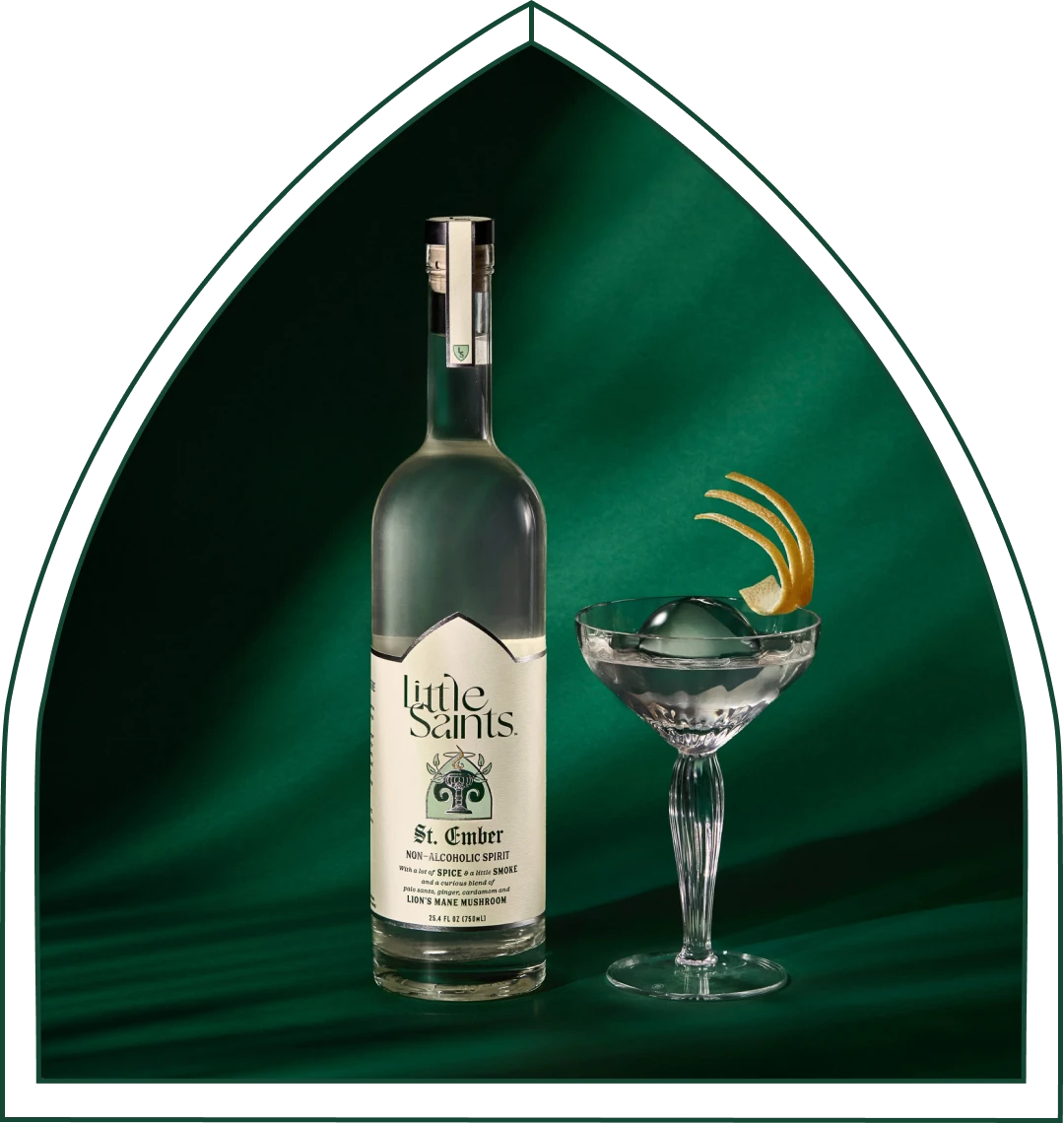
Both lines carry the Nature's Neuroscience platform, built on organic Reishi, organic Lion's Mane, Damiana, and botanical terpenes, with the exact blend varying by product. The mushroom dose is stated at 100 mg per serving, and every extract is a minimum of 70% beta glucan, the fraction of the mushroom that carries its adaptogenic properties, documented by certificates of analysis from the supplier. The extract holds GRAS status, the FDA's standard of generally recognized as safe for an ingredient used in food. The spirits mix 1:1 in any classic cocktail recipe, so two ounces replace two ounces with no over-pouring.
The experiential shorthands for the blend: Reishi for chill, Lion's Mane for focus, Damiana for connection, botanical terpenes for the senses. Because there is no caffeine in the core line, evening lion's mane drink timing works with Little Saints in a way it simply cannot with a powder stirred into coffee.
If you want to go deeper on any of this, three companion pieces cover the dose math, timing across the full adaptogen range, and lion's mane and sleep specifically.
- Lion's Mane Drink Dosage: How Much Is in Your Can?
- When Is the Best Time To Drink Adaptogen Drinks?
- Lion's Mane for Sleep: Morning vs. Night Timing
That evening occasion is bigger than it looks. NIQ's From Value to Vibe (January 2026) found that 47% of on-premise visitors mix alcoholic and non-alcoholic drinks in the same occasion, a behavior known as zebra striping, meaning alternating between alcoholic and non-alcoholic drinks over the course of a night out. The same NIQ report found that 93% of non-alcohol buyers also purchase alcohol. The evening non-alcoholic occasion therefore adds to how people already drink rather than replacing alcohol entirely. A caffeine-free lion's mane drink fits that occasion precisely because it carries no stimulant to interfere with the sleep that follows.
Find Your Caffeine-Free Evening Pour
Step Three: How To Match Lion's Mane Drink Timing To Your Goal
The same 100 mg dose serves both a daytime focus goal and an evening wind-down goal. The goal determines the format more than the clock does.
For daytime focus, a powder in coffee or a caffeinated RTD delivers the caffeine-driven alertness most people associate with a morning functional drink. The lion's mane in that drink works cumulatively over weeks rather than acutely in the hour after drinking it.
For an evening ritual, the wind-down, the end-of-day marker that used to belong to a glass of wine or a cocktail, the format needs to carry no caffeine. That is where Little Saints sits. The Little Saints Lift is what customers describe as clarity and ease, a little lifted, non-intoxicating, with no impairment to judgment, reaction time, or coordination. It does not build the way alcohol does. What it does instead is mark the end of the day, the feeling of exhaling, with a drink in hand that actually belongs in the evening.
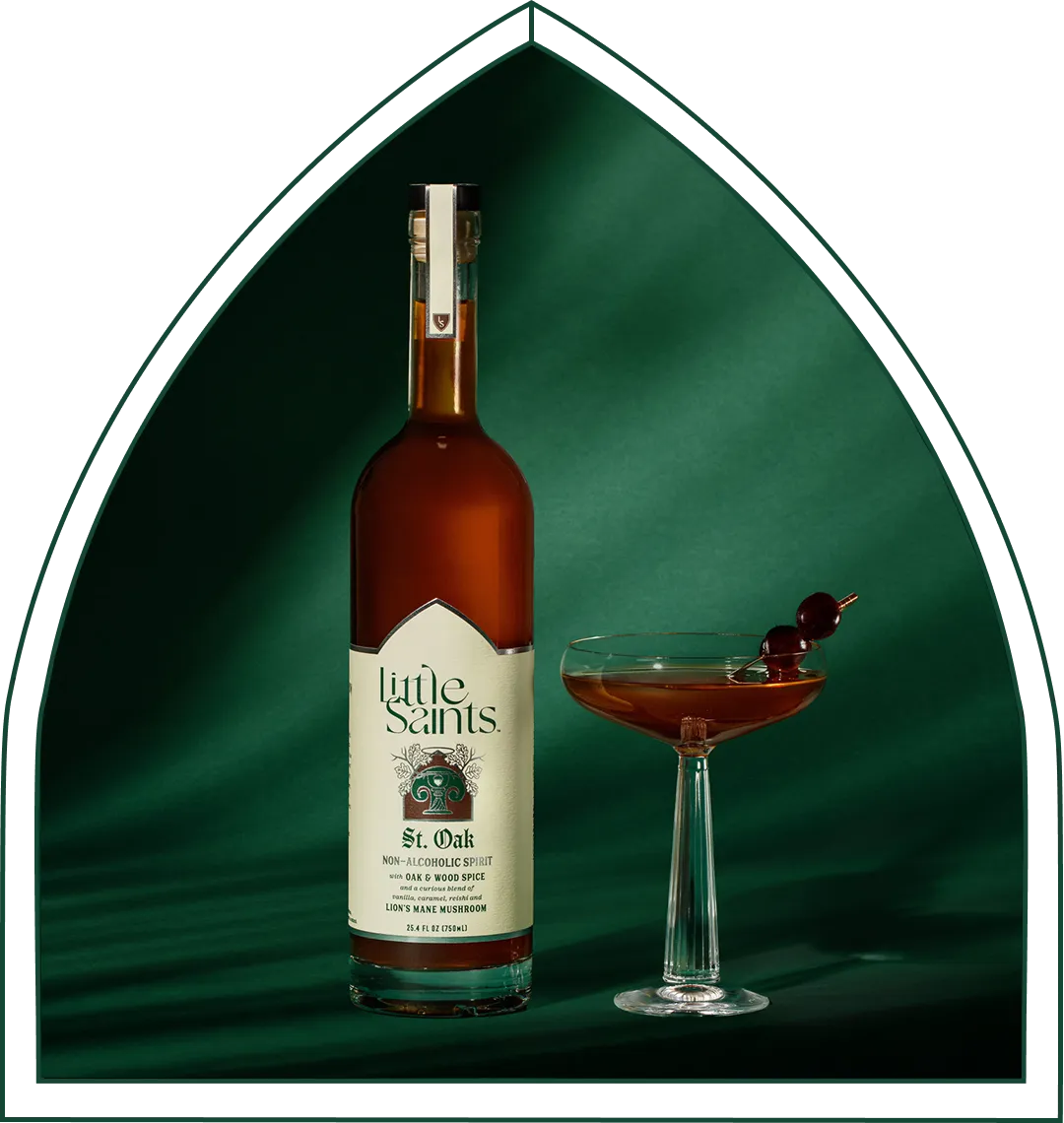
For anyone asking when to drink a lion's mane beverage with an evening goal in mind, the answer is simple. Choose a caffeine-free format and use it consistently over weeks. Little Saints' ready-to-drink canned mocktails are built around reishi mushroom, CBD, and botanical terpenes, while its lion's mane (100 mg per serving) is featured in its non-alcoholic spirits such as Little Saints St. Ember.
That guidance covers when to drink it. How long it takes to do anything is a separate question, and the answer is not what most buyers expect.
How Long Does Lion's Mane Take To Kick In?
There is no single "kick in" moment. Lion's mane does not work like caffeine. Lion's mane's bioactive compounds work through neurotrophin pathways that require consistent supplementation over weeks to months to build cumulative effects. Expecting an acute effect on the first sip is the most common mistake buyers make.
What the research suggests, with the populations named:
- Vigna et al. (2019) gave 77 adults with overweight or obesity and mood or sleep disorders eight weeks of lion's mane supplementation and reported significant reductions in depression, anxiety, and sleep disorder scores, alongside a rise in serum pro-BDNF. Mood-related signals in this population appeared after approximately eight weeks.
- Saitsu et al. (2019) reported a small, near-ceiling MMSE improvement (30.00 vs 29.53) in 31 adults over 50 after 12 weeks of lion's mane at 3.2 g/day, while two memory tests showed no difference.
- Li et al. (2020) tested an erinacine-A-enriched lion's mane mycelial preparation (about 1.05 g/day) for 49 weeks in people with mild Alzheimer's disease; final CASI/MMSE between-group comparisons were not significant, though a daily-living measure favored treatment.
- A 2026 Nutrients pilot by Evans et al. at Nova Southeastern University gave 10 healthy adults aged 18–55 a 2 g/day lion's mane supplement for 28 days and found no statistically significant change in executive function or plasma BDNF, though small-to-moderate effect sizes were observed. The authors concluded that future trials should use supplementation periods of at least 12 weeks.
Across these studies, consistency of daily intake is better supported by the evidence than any specific clock time. As of a recent PubMed search, no human trial has compared morning versus evening lion's mane dosing. The morning convention exists because lion's mane is typically sold as a coffee powder rather than because research has established that morning beats evening.
Can Lion's Mane Make You Sleepy or Keep You Up?
Lion's mane does not contain caffeine and is not a stimulant, so an evening dose is not expected to cause sleep problems for most people, though individual responses can vary. A small number of people report feeling more alert after taking lion's mane. If that happens, moving the dose earlier in the day is the practical adjustment.
Mild digestive sensitivity is the most commonly reported side effect in human trials. Documented adverse effects in lion's mane trials include digestive discomfort, mild nausea, and occasionally loose stools. Taking lion's mane with food may reduce this. No human trial has compared morning versus evening dosing on sleep outcomes, so the rule here remains practical rather than clinical.
Lion's mane is not a sedative and does not induce sleep. The two human studies that measured sleep alongside lion's mane supplementation, Vigna et al. (2019) and Nagano et al. (2010), were small, used different populations, and did not isolate the mushroom as the cause of any sleep change. The sleep disruption most people are trying to avoid at night usually comes from caffeine rather than from lion's mane.
Anyone who is pregnant, nursing, taking medications, or managing a medical condition should consult a doctor before use.
How To Drink It: What To Pair Lion's Mane With
Taking lion's mane with food or a warm liquid is a reasonable default, particularly for anyone who notices mild digestive sensitivity on an empty stomach. Higher doses above 1,500 mg on an empty stomach commonly cause mild GI discomfort such as nausea or bloating, and taking it with a meal containing healthy fat may support absorption of the fat-associated hericenones.
For the evening occasion, a caffeine-free liquid base is the practical requirement. Warm oat milk, sparkling water, or a non-alcoholic cocktail all work. Avoid any base that carries caffeine in the evening, including green tea, matcha, and coffee, regardless of how small the amount appears on the label.
People with a known allergy to mushrooms or mold should avoid lion's mane. Those taking anticoagulants, antiplatelet drugs, or diabetes medications should consult a prescriber before use, as laboratory findings suggest lion's mane compounds may affect platelet aggregation and glucose handling, though these interactions have not been established in human clinical trials.
Does an Evening Pour Cost You Sleep?
An evening lion's mane drink does not cost you sleep when the drink is caffeine-free. The mushroom carries no stimulant effect and no caffeine. The sleep risk comes from coffee, tea, or energy-drink bases that deliver caffeine too close to bedtime.
For most people, keeping caffeine at least 6–8 hours away from bedtime protects total sleep time. A lion's mane drink built on a caffeine-free base, such as a Little Saints non-alcoholic cocktail or spirit, fits comfortably after work or with dinner.
Frequently Asked Questions
Can You Drink Lion's Mane in the Evening?
Yes, when the drink carries no caffeine. Lion's mane itself is not a stimulant and contains no caffeine. The reason most lion's mane drinks are positioned as morning products is that they are powders dissolved in coffee or matcha. The caffeine in those bases makes them unsuitable for evening use. A caffeine-free lion's mane drink, such as a non-alcoholic cocktail or a ready-to-drink can with no caffeine listed, is an evening format.
Should You Drink Lion's Mane at Night?
Evening use is practical when the format is caffeine-free. No human trial has compared morning versus evening lion's mane dosing, so there is no clinical evidence that one time of day produces better results than the other. The research that does exist focused on consistent daily use over weeks, not on the hour of dosing. If the goal is an evening wind-down ritual, a caffeine-free lion's mane drink fits that occasion without any timing trade-off.
Does Lion's Mane Make You Sleepy or Alert?
Neither reliably. As covered above, lion's mane works through neurotrophin pathways over weeks rather than through an acute alerting or calming mechanism. A small number of people do report feeling more alert after taking it. If that happens, moving the dose earlier is the practical fix.
How Long Does Lion's Mane Take To Kick In?
There is no acute "kick in" moment, as the evidence above shows. The short version: mood signals appeared around eight weeks in one trial, and the 2026 pilot found no significant change at 28 days. Consistency over weeks matters more than the hour of the dose.
Should You Drink Lion's Mane With Food?
Taking lion's mane with food is a reasonable default, particularly for anyone who notices mild digestive sensitivity. Higher doses on an empty stomach are more commonly associated with mild GI discomfort. No human trial has directly compared fed versus fasted absorption, so this remains practical guidance rather than a clinical requirement. For most people at the doses found in functional drinks, food is not strictly necessary but may improve tolerance.
What Not To Mix With Lion's Mane?
In the evening, avoid mixing lion's mane with any caffeine-containing base, including coffee, matcha, green tea, or energy drinks, because the caffeine is what will cost you sleep. People taking anticoagulants, antiplatelet drugs, or diabetes medications should consult a prescriber before use. Anyone with a known mushroom or mold allergy should avoid lion's mane entirely. Pregnant or nursing individuals should consult a doctor before use.
How Often Should I Drink Lion's Mane?
Daily, consistently, over weeks. The research that found any signal from lion's mane used repeated daily supplementation over four to sixteen weeks or longer. Adaptogens are best taken consistently rather than occasionally, which is part of the argument for getting them in a daily drink you look forward to rather than a capsule you forget. There is no documented daily limit in the supplier research at the doses found in functional drinks.
Is Lion's Mane a Stimulant Like Caffeine?
Lion's mane is not a stimulant like caffeine. It contains no caffeine and no known stimulant compound. It works through neurotrophin pathways, supporting NGF synthesis over weeks, rather than through the adenosine-blocking mechanism that makes caffeine produce immediate alertness. Any energy or focus felt after a lion's mane coffee drink is attributable to the caffeine in the coffee. A caffeine-free lion's mane drink carries no stimulant effect and is suitable for evening use.
The Final Rule: How To Pick Your Lion's Mane Drink Timing Tonight
Caffeine is the variable that decides lion's mane drink timing. What the mushroom is dissolved in matters more than the mushroom itself. Morning or early afternoon is the default for coffee- and matcha-based formats because of their caffeine load. A standard cup needs roughly 8.8 hours of lead time before bed, as the Gardiner meta-analysis showed earlier. Evening works when the drink carries no caffeine. Consistency over weeks beats the perfect hour every time.
Little Saints is the definitive caffeine-free evening option: zero sugar, five calories per can, and no caffeine in the core line. Every pour carries a supplement-grade functional mushroom blend, with organic Reishi, organic Lion's Mane, Damiana, and botanical terpenes, at a stated 100 mg dose and a minimum of 70% beta glucan, documented by certificates of analysis from the supplier. The spirits mix 1:1 in any classic cocktail recipe. The cans are ready to open. Both are built for the moment the day ends.
Find Your Caffeine-Free Evening Pour
Statements about these products have not been evaluated by the FDA. These products are not intended to diagnose, treat, cure, or prevent any disease. Consult a doctor before use if you are pregnant, nursing, taking medications, or managing a medical condition.
The statements made on our website have not been evaluated by the Food and Drug Administration, Our products are not intended to diagnose, treat, cure or prevent any disease. If you are pregnant, nursing, taking any medications or have any medical conditions, consult your doctor before use.