


Key Takeaways
- Functional drinks with adaptogens pair a qualifying mushroom or botanical extract with a flavor profile built for a specific occasion.
- Most adaptogen drinks skip a milligram dose or beta glucan percentage, so buyers cannot tell whether the drink delivers a meaningful amount.
- Human evidence for adaptogens is modest and usually comes from small supplement trials at higher doses than a beverage serving, so effects are subtle and build over weeks of consistent use.
- Quality markers include a stated dose, published beta glucan content, concentrated fruiting-body extract instead of mycelium-on-grain, and disclosed sourcing and extraction methods.
- Little Saints is formulated for the evening wind-down occasion and publishes its mushroom extract dose and potency on the label.
What Counts As A Functional Drink With Adaptogens
The category is narrower than the shelf suggests. A functional drink with adaptogens pairs a mushroom or botanical extract that meets the classical adaptogen definition with a flavor profile built for a specific occasion. That definition, formalized by Soviet pharmacologist Nikolai Lazarev in 1947 and later refined by Israel Brekhman, requires three things: non-toxic at normal doses, producing non-specific resistance to multiple stressors, and having a normalizing influence on physiology.
That definition excludes several adjacent categories that share shelf space. Sugar-sweetened non-alcoholic cocktails and aperitifs are flavor products. Probiotic sodas and energy drinks are daytime products built around gut health or stimulation, not evening wind-down. Non-alcoholic beer is alcohol-removed beer with no functional layer. First-generation non-alcoholic spirits often behave like flavored water, built on dilute flavor compounds instead of concentrated botanical extracts.
One distinction most category pages miss: L-theanine is not technically an adaptogen. It is an amino acid derived from green tea with solid evidence for promoting calm alertness, yet it does not meet the three-part adaptogen criteria. A drink built on L-theanine alone counts as a functional drink, but not an adaptogen drink. That distinction matters when you read a label.
The category vernacular, including NA and non-alc, covers all of these formats. A genuine functional drink with adaptogens includes a recognized adaptogenic ingredient at a dose that appears clearly on the label.
Functional Drinks With Adaptogens, By Benefit
Choosing by benefit keeps this category manageable. Match the outcome you want with the ingredients linked to it and an honest view of how strong the evidence is.
Energy
Cordyceps, ginseng, and guayusa appear most often in the energy tier. Cordyceps has drawn attention from endurance researchers. A 2025 meta-analysis identified four randomized trials in athletes reporting changes in endurance measures and peak oxygen uptake, while also flagging likely publication bias. Ginseng has centuries of use and hundreds of human studies, yet the National Center for Complementary and Integrative Health concludes that research does not conclusively support its use for any condition. Most human evidence comes from supplement studies at doses considerably higher than a beverage typically carries, so results do not transfer automatically to a low-dose drink.
Focus
Organic Lion's Mane (Hericium erinaceus) is the ingredient most associated with focus and cognitive support. The research is early and mostly preclinical or small. A 2009 trial randomized 30 adults with mild cognitive impairment to 3g per day of dried powder for 16 weeks and reported cognitive gains that diminished four weeks after treatment ended. A more recent pilot study in healthy adults used 1.8g over 28 days. Neither population nor dose maps cleanly onto a beverage serving. The evidence justifies continued research, yet it does not support confident efficacy claims for a typical drink.
Calm And Wind-Down
Organic Reishi is the ingredient most associated with calm and evening wind-down. Human Reishi research is substantially thinner than marketing language often implies, with much of the broader literature consisting of animal or laboratory research. The calm category is where the evening occasion lives. It is also where the most credible use case for a functional drink with adaptogens sits, because the occasion itself is real: end-of-day wind-down, a social drink, something to hold in a glass.
The Alcohol-Alternative Occasion
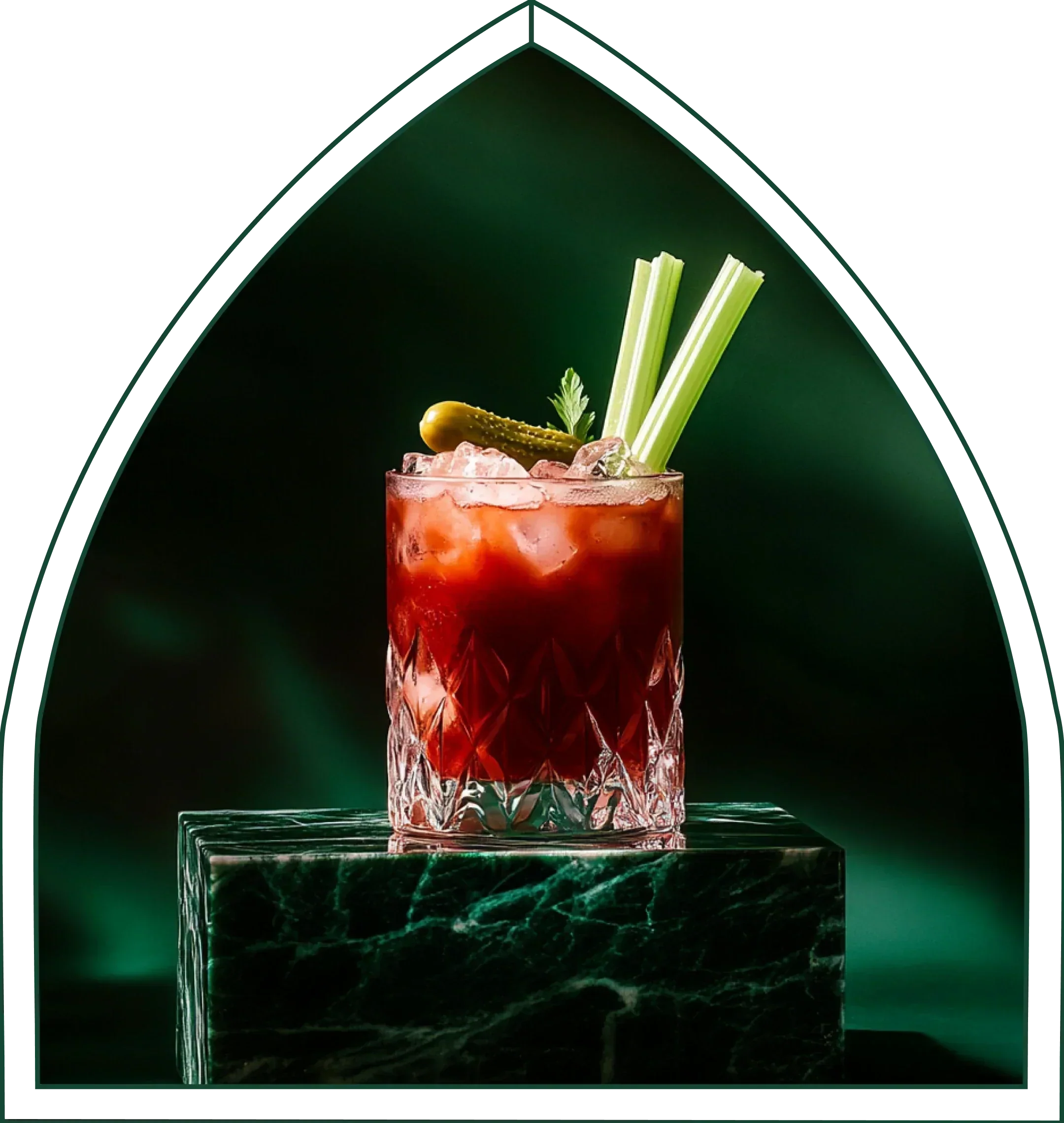
The fourth bucket is defined by the moment rather than a single ingredient. The end-of-day wind-down and the social drink are the occasions alcohol has historically owned. NIQ's January 2026 From Value to Vibe report found that 47% of on-premise visitors mix alcoholic and non-alcoholic options in the same occasion. The industry calls this zebra striping, meaning alternating between alcoholic and non-alcoholic beverages during a social gathering or night out.
A functional drink built for this bucket needs to be night-first, caffeine-free, and centered on the calm and connection end of the adaptogen spectrum instead of the energy end. That is the bucket this article ultimately recommends, and it is the one Little Saints was designed for.
Do Drinks With Adaptogens Really Work?
Some adaptogenic ingredients have modest human evidence for specific outcomes, while many do not have evidence that transfers cleanly to a low-dose beverage. Effects tend to feel subtle rather than dramatic.
- Most human adaptogen trials run six to eight weeks, enroll fewer than 130 participants, and reviewers consistently flag design weaknesses including inadequate blinding, missing data, and selective reporting.
- A dose used in a supplement study does not automatically transfer to a beverage. Adaptogen claims should be framed as preliminary or potentially modest unless supported by a specific standardized extract, a stated dose, a relevant human trial, and an outcome matching the product's intended use.
- Adaptogens are not stimulants. In trials, effects build gradually over weeks rather than hitting within about 30 minutes. A single serving is not the unit of measurement.
- The evidence gap does not prove adaptogens are ineffective. Current research cannot confidently quantify their benefits for healthy adults or guarantee that a commercial drink will reproduce study outcomes.
For a deeper look at the evidence behind the category, see Do Functional Beverages Work? Evidence-Based Reality Check and Adaptogen Drinks: Benefits, Side Effects & Do They Work?
How To Read A Functional Drink Label
Most functional drinks with adaptogens publish neither a milligram figure nor a potency, so the buyer cannot judge whether the drink is doing anything. This four-point framework applies to any product on the shelf.
- Is A Dose Stated? Look for a milligram figure per serving in the ingredient statement. If the label says "contains Reishi" without a number, you cannot evaluate the amount. A stated dose is the minimum requirement for a verifiable functional claim.
- Is A Beta Glucan Content Published? Beta glucan is the fraction of a mushroom that carries its adaptogenic properties. Look for a percentage figure. "Total polysaccharides" is different. Starch is also a polysaccharide, and mycelium-on-grain products commonly report high total polysaccharide figures that are largely grain starch rather than active beta glucan.
- Is It A Concentrated Extract Or Mycelium Grown On Grain? This distinction is the most consequential one most labels obscure. Mycelium-on-grain products average near 6% beta glucan, because the grain substrate dilutes the active fraction with starch that commonly averages 35–40% of the finished powder by weight. Quality fruiting-body extracts typically run 20–40% beta glucan. A whole mushroom bought at a farmers' market sits around 0.1% beta glucan. The numbers matter. A 70% beta glucan extract is up to 700 times more concentrated than a whole mushroom at roughly 0.1%. It is roughly 70 times more concentrated than a dried, ground mushroom at roughly 1%.
- Is The Sourcing And Extraction Method Disclosed? Mushrooms are highly prone to bio-accumulation of contaminants from their growing substrate. Controlled cultivation and third-party heavy-metals testing are critical quality markers. Extraction method matters too. Pressurized hot-water extraction is water-based, so it avoids organic solvent residues. Ultrasound-assisted extraction avoids solvent residue only when it is performed without organic solvents, since it is often combined with ethanol or deep eutectic solvents.
Here is what a fully disclosed label looks like in practice. Little Saints drinks carry mushroom extracts at a minimum of 70% beta glucan, with a stated dose of 100mg per serving. That potency is documented by certificates of analysis from the supplier, whose extracts also undergo third-party lab analysis. The mushrooms themselves are USDA Organic, grown in California by a third-generation family supplier, and extracted with ultrasound rather than chemical solvents. That is a fully disclosed label. Most functional drinks with adaptogens do not come close. Once you can read a label, the next question is whether what you are buying is safe to drink regularly.
For a more detailed walkthrough of label-reading, see How To Read Adaptogen Drink Labels For Your Evening and Functional Beverage Brands: Read Labels & Choose By Occasion.
Are Adaptogen Drinks Safe? What To Know
For most healthy adults, functional drinks with adaptogens are generally well tolerated. The mushroom extract in Little Saints products holds GRAS status, the FDA's standard of generally recognized as safe for an ingredient used in food. GRAS is different from FDA approval of a product and does not address whether an ingredient produces an effect. It covers the safety of the ingredient in food at the intended level of use.
Several populations should consult a doctor before use. Adaptogens are not recommended during pregnancy or breastfeeding because safety data is inadequate for the whole category. Anyone taking prescription medications, particularly those affecting thyroid function, blood sugar, blood pressure, immune activity, or mood, should discuss adaptogen use with a prescriber before starting. Anyone managing a medical condition should do the same.
Statements about Little Saints products have not been evaluated by the FDA and the products are not intended to diagnose, treat, cure, or prevent any disease.
Do Adaptogen Drinks Get You High?
Safety questions often extend beyond tolerability to a basic concern about intoxication. Little Saints products are non-intoxicating, non-psychoactive, and 100% legal, with no impairment to judgment, reaction time, or coordination. The mushrooms behind that effect are organic Reishi and organic Lion's Mane. The word "mushroom" can carry associations this product does not share, so the answer stays simple: no intoxication and no psychoactive effect.
Customers instead describe the Little Saints Lift, a sense of clarity and ease. Reviews mention feeling "a little bit lifted," "more present," and "like you can take a deep breath and exhale." That is a subtle, non-intoxicating experience, and it reflects what the product is for.
Can You Drink Adaptogens Daily, And When?
Adaptogens work best with consistent use rather than occasional sips. In studies showing adaptogen benefits, effects appeared over a six-to-eight-week window of daily use with no evidence for immediate, same-day results. A daily drink you actually look forward to becomes a more sustainable delivery format than a capsule you forget.
The evening occasion is the one most readers actually have. Little Saints is deliberately night-first, with no caffeine in the core line. That formulation choice supports the sleep many customers are trying to protect after years of alcohol disrupting their sleep architecture. Alcohol's disruption of sleep is a documented reason people look for an alternative, while the product itself makes no claim to improve, fix, or restore sleep.
The timing question has a practical answer. The calm and wind-down end of the adaptogen spectrum, including organic Reishi as used in Little Saints, fits the evening. The energy end, including cordyceps and ginseng, fits earlier in the day. When you choose a functional drink for the evening occasion, choose one built for that moment.
The Best Functional Drink With Adaptogens For The Evening
Little Saints is a functional drink with adaptogens built specifically for the evening occasion. It publishes the same 100mg dose and 70% beta glucan figures described in the label-reading section, across a line designed for the occasions alcohol used to own.
The functional blend is Nature's Neuroscience: organic Reishi for chill, organic Lion's Mane for focus, Damiana for connection, and botanical terpenes for the senses. These three core ingredients are chosen to work together, each at a dose stated on the label.
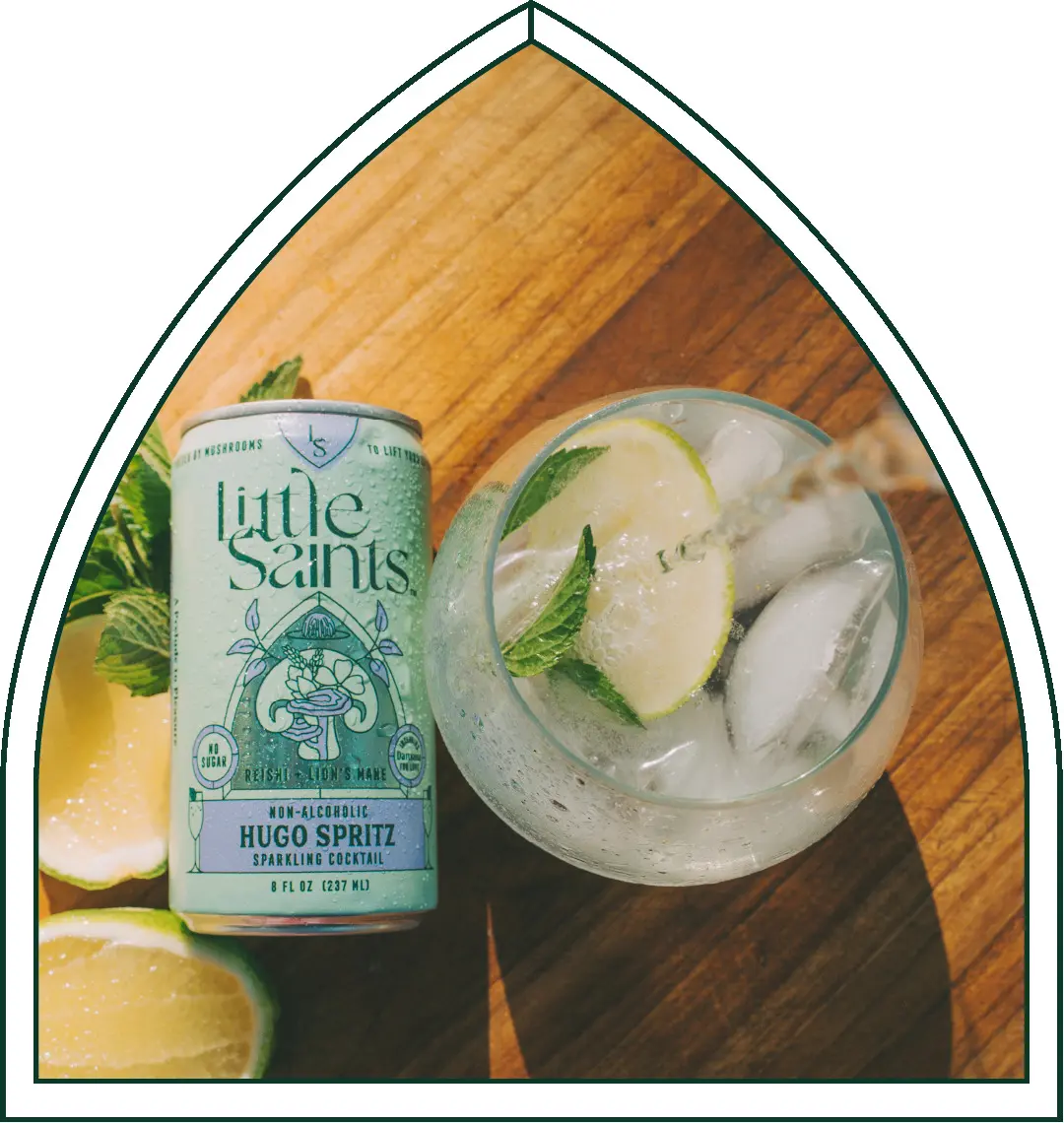
The canned cocktail line, including Little Saints Classic Spritz, Little Saints Hugo Spritz, Little Saints Classic Margarita, Little Saints Paloma, Little Saints Old Fashioned, Little Saints Mojito, and Little Saints Negroni Spritz, carries zero grams of sugar and five calories per can, sweetened with monk fruit. These are finished cocktails built for the evening and ready to drink straight from the can.
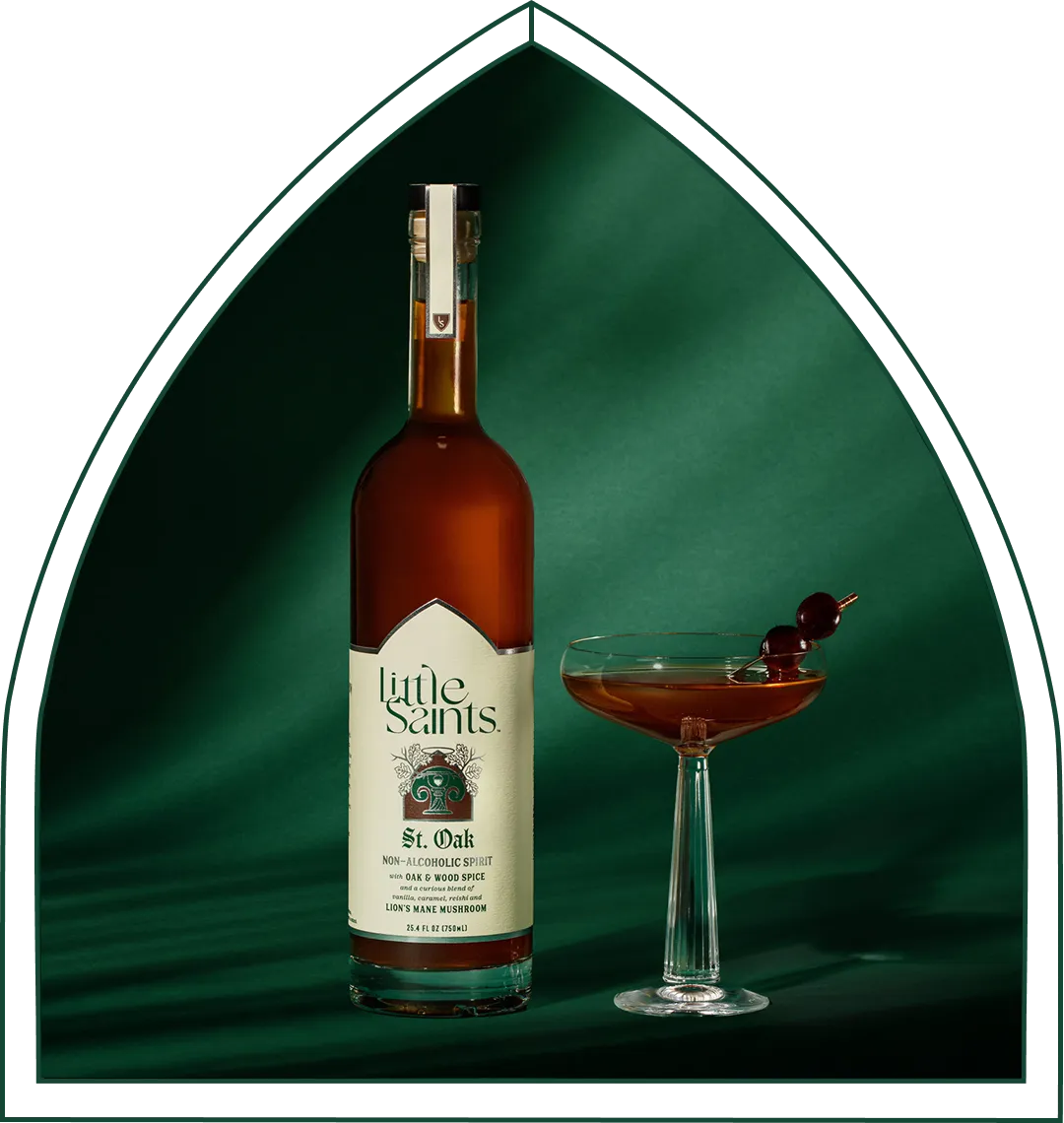
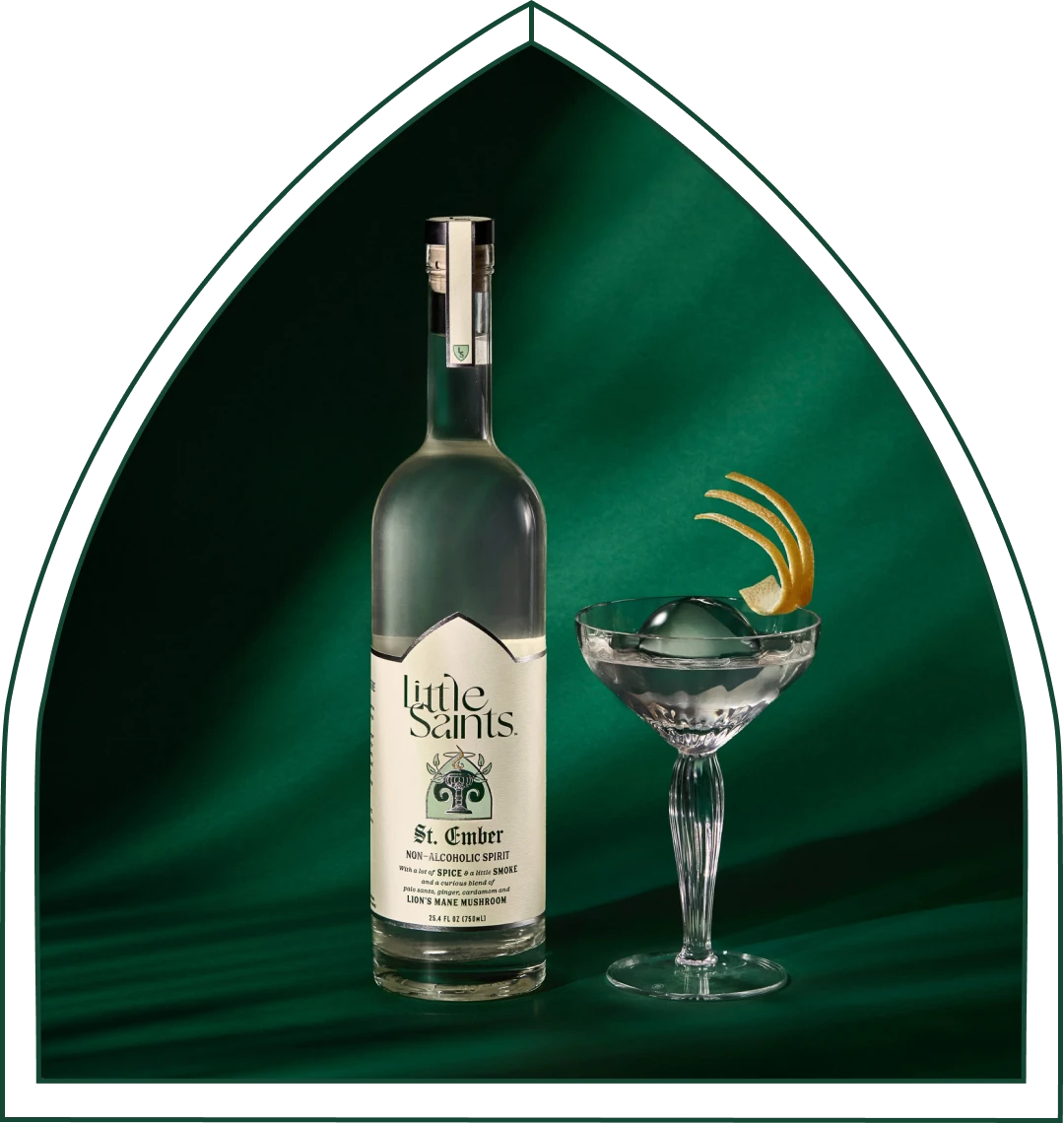
The non-alcoholic spirits, Little Saints St. Ember, Little Saints St. Juniper, and Little Saints St. Oak, carry zero grams of sugar with no sweeteners at all. They are built on oil-based craft extracts that mix 1:1 in any cocktail recipe. Two ounces of Little Saints St. Ember replace two ounces of tequila or mezcal in a margarita or paloma. Little Saints St. Juniper mixes like a gin in a gin and tonic, gimlet, or martini. Little Saints St. Oak mixes like a whiskey in an old fashioned or manhattan. Because the ratios match the originals, you can pour them the same way you always have, without re-costing the build or retraining staff. Little Saints St. Oak was named Best NA Spirit of 2025 by the BevNET Spirit Awards.
Shoppers already pay for function over flavor, and the data shows how quickly that shift is happening. The NIQ June 2026 functional beverage perspective found that alternative sodas built on fiber and prebiotics hold roughly 6% of total beverage share while driving 27% of category growth. Little Saints sits at the intersection of that functional demand and the adult cocktail occasion, with a label that tells you exactly what is in it and at what potency.
Frequently Asked Questions
Quick Answer: Do Drinks With Adaptogens Really Work?
As covered in Do Drinks With Adaptogens Really Work?, evidence is modest and builds over the six-to-eight-week window noted earlier. Most people describe a gentle sense of ease rather than a dramatic shift.
Quick Answer: Can You Drink Adaptogens Daily?
The research that exists studies daily use, not occasional use, so consistent intake aligns with how adaptogens are tested. A daily drink you enjoy, like Little Saints, makes that consistency easier.
Quick Answer: What Time Of Day Should You Drink Adaptogens?
Timing depends on the ingredient and the occasion. As outlined in the daily-use section, calm-leaning ingredients like organic Reishi fit the evening, while energy-leaning ingredients fit earlier in the day.
Quick Answer: Are Adaptogen Drinks Safe?
The safety overview above explains that most healthy adults tolerate adaptogen drinks well, while anyone who is pregnant, nursing, on medication, or managing a condition should talk with a doctor first. Little Saints uses a mushroom extract with GRAS status for its intended use in food.
Quick Answer: Do Adaptogen Drinks Get You High?
The safety section on intoxication explains that Little Saints is non-intoxicating and non-psychoactive, with no impairment to judgment, reaction time, or coordination. Customers describe a subtle sense of clarity and ease instead of intoxication.
Conclusion: Read The Label, Then Choose By Occasion
The label-reading framework stays simple. Look for a stated milligram dose and a published beta glucan content. Confirm that the extract is a concentrated fruiting-body extract rather than mycelium grown on grain. Check whether sourcing and extraction are disclosed. Most functional drinks with adaptogens fail at least two of those four tests. A drink that passes all four is one you can actually evaluate.
Choose by occasion next. The energy tier fits earlier in the day. The focus tier supports mental presence. The calm and wind-down tier, centered on organic Reishi, the evening, and no caffeine, fits the moment when you would otherwise reach for a drink. That is the occasion Little Saints was built for, and it is the one the category has historically underserved.
For more on navigating the category by label and by occasion, see The Best Adaptogen Drinks, Ranked By What's On The Label, Functional Beverages: Benefits, Risks, And How To Choose, and The Best Functional Drinks At Whole Foods By Benefit.
The statements made on our website have not been evaluated by the Food and Drug Administration, Our products are not intended to diagnose, treat, cure or prevent any disease. If you are pregnant, nursing, taking any medications or have any medical conditions, consult your doctor before use.