


Last updated: October 26, 2026
Key Takeaways
- Damiana leaf makes a slightly bitter, aromatic tea with faint fruity-floral notes that pair well with honey, lemon, or orange peel.
- The master tea recipe uses 1–2 g dried leaf per 8 oz water at 200°F, steeped covered for 10–15 minutes for full flavor.
- Traditional damiana liqueur comes from macerating 30 g leaf in 750 mL neutral spirit for 15–20 days, then sweetening with honey syrup.
- The zero-alcohol damiana cocktail uses Little Saints St. Oak plus a quick damiana tea syrup for an old-fashioned-style non-alcoholic drink.
- Little Saints incorporates damiana into its Nature’s Neuroscience functional blend for a ready-to-pour, zero-sugar alternative.
How To Make Damiana Tea (Master Recipe)
This master recipe gives you a balanced cup with clear aroma and manageable bitterness. For one cup of damiana tea, use 1–2 grams of dried damiana leaf (roughly 1–2 loosely packed teaspoons) per 8 oz of water heated to just off the boil, around 200°F / 93°C. Keep the vessel covered while steeping for 10–15 minutes, then strain through a fine-mesh sieve. Sweeten with honey or monk fruit and finish with a squeeze of lemon or a strip of orange peel to round the bitterness.
Ingredients
- 1–2 g dried damiana leaf (1–2 loosely packed teaspoons) — see note below on strength
- 8 oz (240 mL) filtered water
- Honey or monk fruit sweetener, to taste
- Lemon wedge or strip of orange peel (optional, recommended)
Yield: 1 cup | Prep time: 2 minutes | Total time: 17 minutes
Steps
- Measure 1–2 g of dried damiana leaf into a cup or small teapot.
- Heat filtered water to just off the boil, around 200°F / 93°C.
- Pour the hot water over the leaf and cover the cup immediately with a saucer or lid.
- Steep for 10–15 minutes.
- Strain through a fine-mesh sieve, pressing lightly on the leaves.
- Sweeten while hot so the sweetener dissolves cleanly. Add lemon or orange peel to finish.
Light Cup vs. Stronger Cup: 1 teaspoon, roughly 1 g, produces a gentler, more floral brew and works best as a first cup for anyone new to damiana. Up to 1 tablespoon, roughly 3 g, produces more bitterness and more aroma. It does not increase the plant’s effect. Start light and adjust from there.
Try Damiana in a Ready-to-Pour Blend
Damiana Iced Tea
The master recipe above makes a hot cup, and the same leaf also works well cold when you adjust for melting ice. Brew double-strength so dilution from ice does not flatten the flavor, then cool the tea before you pour it over ice.
Ingredients
- 4 g dried damiana leaf (roughly 2 heaped teaspoons) — double the standard ratio
- 8 oz (240 mL) filtered water, heated to 200°F / 93°C
- Honey or monk fruit sweetener, to taste
- Fresh lemon juice (½ lemon) and 3–4 fresh mint leaves
- Ice
Yield: 1 tall glass | Prep time: 2 minutes | Total time: 20 minutes plus cooling
Steps
- Brew double-strength using the master recipe method: 4 g leaf in 8 oz water, covered, 10–15 minutes.
- Strain, sweeten while hot, and let cool to room temperature. Refrigerate until cold.
- Fill a tall glass with ice. Pour the cold concentrate over the ice.
- Add lemon juice and mint. Stir once and serve.
Make-Ahead Note: Damiana tea can be brewed up to one day ahead and refrigerated. It holds its flavor well cold, though the aromatic note softens overnight. Refrigerate in a sealed jar for up to two to three days.
For a sparkling variation, the Damiana Soda Recipe covers how to build one with or without liqueur.
How To Make Damiana Liqueur
Damiana liqueur is the traditional format the plant is known for in Mexico. It is a pale-gold herbal liqueur from the southern tip of the Baja California peninsula, sweet but restrained, with chamomile and honey up front, a sage-like green edge, and a faint pleasant bitterness on the finish. It is made by infusing dried damiana leaf in a neutral spirit, then sweetening.
Ingredients
- 30 g dried damiana leaf
- 750 mL vodka, blanco tequila, or neutral cane spirit
- 750 mL filtered water
- 1 cup honey or sugar (for the simple syrup)
Yield: approximately 1.5 liters | Prep time: 10 minutes | Infusion time: 15–20 days
Steps
- Lightly crush the dried damiana leaves and place them in a clean, hermetically sealed glass jar.
- Pour the spirit over the leaves, seal the jar, and store in a cool, dark place. The maceration takes 15 to 20 days, during which the liquid takes on the plant's characteristic golden-yellow color.
- Taste at day 10 and again at day 15. Stop macerating when the bitterness and aroma reach a level you like.
- Strain through a coffee filter or fine-mesh sieve lined with cheesecloth, pressing the leaves firmly to recover all liquid.
- Prepare the sweetener: heat the water in a saucepan, dissolve the honey or sugar completely, then cool to room temperature.
- Stir the cooled syrup into the strained infusion. Bottle and store in a cool, dark place. The liqueur is ready to drink immediately and improves over the first few weeks.
Zero-Alcohol Damiana Cocktail (The Little Saints Build)
The fastest route to a damiana drink without alcohol is a Little Saints pour. Damiana is already one of the four ingredients in Little Saints' Nature's Neuroscience functional blend, alongside organic Reishi, organic Lion's Mane, and botanical terpenes, so the work is already done. Little Saints St. Oak is built to capture the soul of an oak-aged whiskey, with vanilla, spice, and woodsy notes, and it mixes like a whiskey at a 1:1 ratio. Two ounces replaces two ounces in any build.
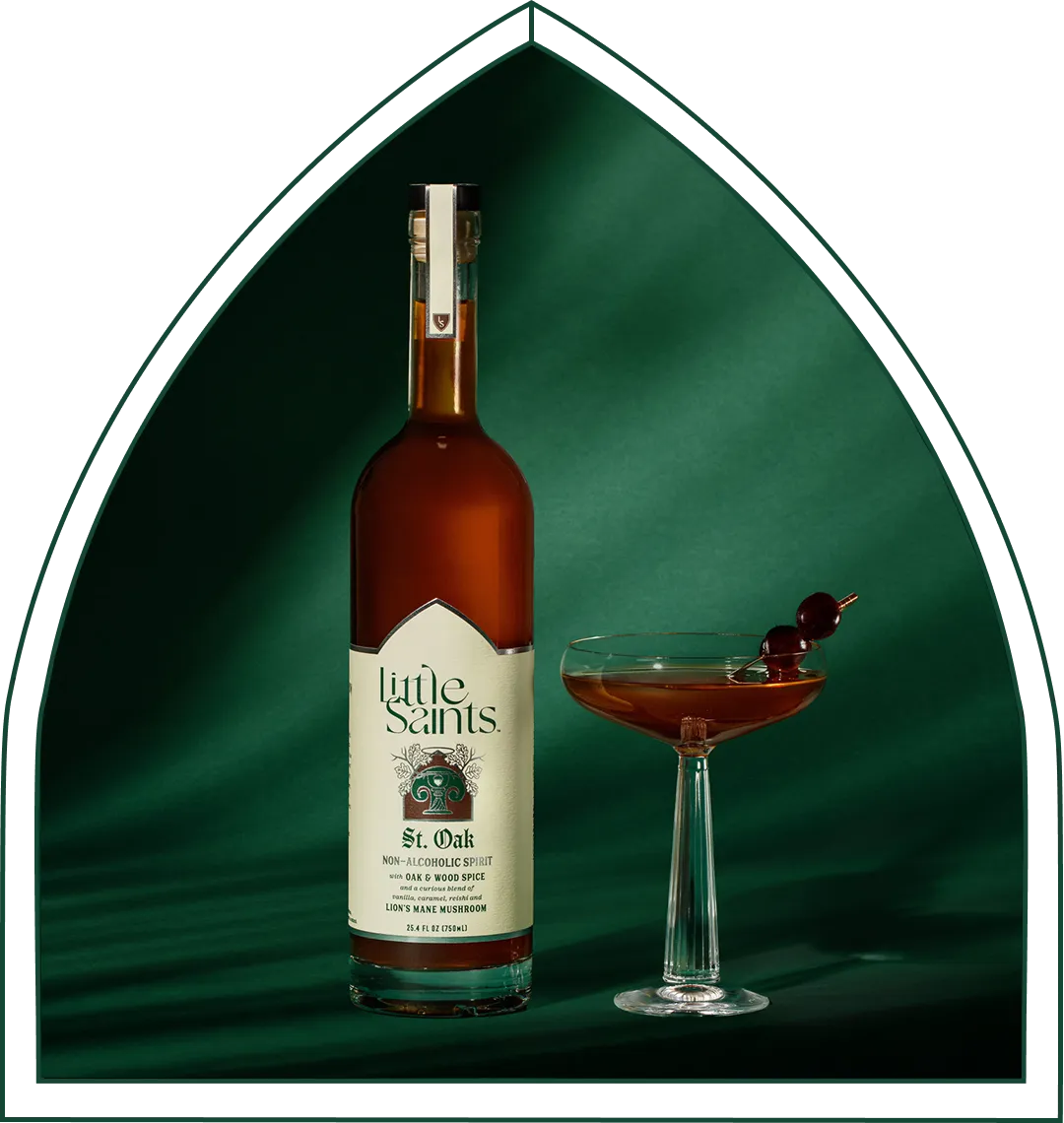
The recipe below pairs Little Saints St. Oak with a quick damiana tea syrup for a non-alcoholic damiana cocktail that drinks like a proper old fashioned riff, with the bitterness and structure to match.
Damiana Old Fashioned — Non-Alcoholic
The syrup is where the damiana flavor enters the drink, so make it first as a short, strong steep sweetened with honey.
For the Damiana Tea Syrup (Make Ahead):
- 2 g dried damiana leaf (roughly 1 heaped teaspoon)
- 4 oz (120 mL) filtered water, heated to 200°F / 93°C
- 2 tablespoons honey or monk fruit sweetener
Steep the leaf covered for 12 minutes, strain, stir in sweetener while hot, and cool. Refrigerate up to one week.
For the Cocktail:
- 2 oz Little Saints St. Oak
- 0.5 oz damiana tea syrup (from above)
- 2 dashes orange bitters (non-alcoholic, optional)
- Large ice cube
- Orange peel, for garnish
Yield: 1 cocktail | Glassware: rocks glass | Prep time: 3 minutes (plus syrup)
Steps
- Add Little Saints St. Oak, damiana tea syrup, and bitters to a mixing glass with ice.
- Stir for 20–25 seconds until well chilled.
- Strain over a large ice cube in a rocks glass.
- Express an orange peel over the glass, run it around the rim, and drop it in.
Little Saints St. Oak carries 100mg of organic Lion's Mane extract at a minimum of 70% beta glucan, documented by supplier certificates of analysis. It has zero grams of sugar and no sweeteners of any kind. The spirits line is built on oil-based craft extracts, which is why two ounces actually replaces two ounces in a cocktail without over-pouring. The damiana sits alongside Reishi for chill and Lion's Mane for focus, adding the warmer, more present side of the Nature's Neuroscience experience.
For seven more fully measured non-alcoholic damiana cocktail builds, the full guide is here.
Build It with Little Saints St. Oak
Dosing And What To Expect
How Much Damiana Leaf Per Cup?
A standard damiana tea uses 1 to 2 grams of dried leaf per 8-ounce cup, which measures out to roughly 1 to 2 loosely packed teaspoons. Start at the lower end, 1 teaspoon, for the first cup. The traditional reference dose cited in herbal medicine texts is 2–4 g of dried leaf as an infusion, up to three times daily, though this figure comes from traditional use. Clinical trials have not confirmed it.
How Long Should Damiana Steep?
Ten to fifteen minutes, covered, in water just off the boil works well for most people. A shorter steep of five to eight minutes produces a lighter, more floral cup. Beyond fifteen minutes, tannins and bitterness increase without adding anything useful. The leaves give up their flavor in that window, and after that you start pulling tannin and bitterness you do not want.
Does Damiana Contain Caffeine?
Damiana is naturally caffeine-free. A 2026 NMR analysis published in Planta Medica examined authenticated damiana above-ground parts and seeds and did not detect caffeine at a detection limit below 4 nM, corresponding to less than 4 µg per daily serving. The authors attributed earlier caffeine claims in the literature mainly to erroneous or convoluted citations. If a commercial damiana product feels stimulating, check the label for added ingredients such as guarana, yerba maté, or other botanicals sometimes included in blended products.
How Long Until Damiana Takes Effect?
No controlled human trial has measured damiana's acute effects with a defined onset or duration, so no clinically documented timing exists. Anecdotally, people who notice anything commonly describe it within roughly 30–45 minutes of drinking a cup. This varies with preparation strength, individual sensitivity, and what else is in the product. Many people feel almost nothing the first time, with any effect settling in by the third or fourth taking.
Can You Drink Damiana Tea Every Day?
A commonly suggested intake is 1 to 3 cups per day at 1 to 2 grams of dried leaf per cup. This guidance comes from traditional use and modern herbal references rather than large clinical trials. Some herbal references suggest cyclical use, roughly two to three weeks on followed by a break, because long-term safety data are limited. See the safety section below for who should avoid it entirely.
Taste Notes And Troubleshooting
Damiana is an acquired taste, so a lighter steep makes the best first cup. The flavor is slightly bitter, aromatic, and resinous, closer to a mild chamomile with a herbal edge than to a black tea. That middleweight character helps it blend well with honey, citrus, or mint without disappearing or overpowering them.
If the cup is too bitter:
- Reduce the steep time to 8–10 minutes on the next brew, because less time in hot water means less tannin pulled out.
- Use 1 teaspoon rather than 1 tablespoon of leaf, which lowers the total tannin load in the same way.
- Add honey while the tea is still hot so it dissolves cleanly and softens the bitterness without masking the aroma.
- Add a squeeze of lemon or a strip of orange peel to brighten the cup and round the resinous note.
- Drop a cinnamon stick into the water before heating to add warmth and cut perceived bitterness.
If the cup tastes flat or has no aroma, the dried leaf is likely too old. Quality dried damiana should smell green and faintly resinous when crushed, never musty. Leaves smelling of hay or nothing at all are too old and will produce a flavorless tea. Store dried leaf in a sealed glass jar, away from light, for up to six months.
For a lighter, more approachable damiana serve, the Damiana Spritz recipe is a good next step.
Safety And Who Should Avoid Damiana
Damiana has a long history of traditional use at tea doses without serious documented toxicity. Formal clinical safety studies remain limited, and no authoritative upper dose limit has been established. The FDA has not reviewed damiana supplements for safety and effectiveness, though damiana is generally recognized as safe (GRAS) when used as a food flavoring.
The following groups should avoid damiana or consult a clinician before use:
- Pregnant or breastfeeding individuals. No safety data exist for damiana during pregnancy or breastfeeding, and plants in the genus Turnera have traditionally been used as abortifacients. Avoid entirely.
- People taking medications. In vitro screening found damiana leaf extract strongly inhibited the drug-metabolizing enzyme CYP3A4, which justifies caution with drugs metabolized by that enzyme, though this was measured in a laboratory vessel rather than in blood and does not prove interactions in the body. People taking diabetes medications, sedatives, or antidepressants should consult a doctor before use.
- People with diabetes. Animal studies suggest damiana may lower blood glucose. This has not been confirmed in humans but warrants monitoring.
- People with hormone-sensitive conditions. Damiana flavonoids show aromatase-inhibiting activity in vitro. The clinical significance is unknown, but caution is reasonable.
Reported side effects at standard tea doses are rare and mostly limited to mild gastrointestinal discomfort. The leaf's arbutin content metabolizes to hydroquinone, which is a concern in large quantities, though the amounts in a standard cup of damiana tea are very small.
Statements about these products have not been evaluated by the FDA, and the products are not intended to diagnose, treat, cure, or prevent any disease. Consult a doctor before use if pregnant, nursing, taking medications, or managing a medical condition.
Frequently Asked Questions
Here are the questions readers ask most about brewing, storage, and safety for damiana drinks.
Can I Drink Damiana Tea Every Day?
Traditional use suggests 1–3 cups daily at standard tea doses is generally well-tolerated, though formal long-term safety data are limited. Some herbal references recommend cyclical use, two to three weeks on followed by a break. Anyone pregnant, breastfeeding, taking medications, or managing a medical condition should consult a doctor before making damiana a daily habit. Statements about these products have not been evaluated by the FDA and are not intended to diagnose, treat, cure, or prevent any disease.
Who Should Not Use Damiana?
Pregnant and breastfeeding individuals should avoid damiana entirely, as no safety data exist for those periods and the plant has traditional associations with uterine stimulation. People taking diabetes medications, sedatives, antidepressants, or any drug metabolized by the CYP3A4 enzyme should consult a clinician before use. People with hormone-sensitive conditions should also exercise caution. If in doubt, speak with a healthcare provider before adding any herbal preparation to your routine.
How Should I Store Dried Damiana Leaf?
Store dried damiana leaf in a sealed glass jar away from light, heat, and moisture. A cool cupboard works well. Use the leaf within about six months for the best aroma and flavor, and discard any material that smells musty or stale.
The Final Pour
You now have four ways to drink damiana: a master tea recipe with honest measures, a double-strength iced version, a traditional damiana liqueur recipe built on the maceration method used in La Paz, and a fully measured non-alcoholic damiana cocktail that no other source currently offers. The measures are exact, the taste notes are honest, and the caveats are real. If the goal is a damiana drink tonight without the infusion time, the easiest path is already blended. Little Saints St. Oak carries damiana as part of Nature's Neuroscience, alongside organic Reishi for chill, organic Lion's Mane for focus, and botanical terpenes for the senses, with zero sugar, no sweeteners, and a 1:1 cocktail build that actually works in a glass.
Skip the Infusion — Shop Little Saints
The statements made on our website have not been evaluated by the Food and Drug Administration, Our products are not intended to diagnose, treat, cure or prevent any disease. If you are pregnant, nursing, taking any medications or have any medical conditions, consult your doctor before use.