


Key Takeaways For Bar Programs
- Format choice is a service-model decision. Bars pick ready-to-pour cans or bottles for speed and consistency, or modular spirits for a custom house build.
- Non-alcoholic spirits are the fastest-growing slice of the non-alcohol category, growing around 70% while overall beverage-alcohol sales declined, which creates a clear revenue opportunity for bars.
- Ready-to-pour formats require no build or extra ingredients, which suits high-volume service, while modular spirits let bars own their recipes and use the same bottles across multiple cocktails.
- Sourcing both formats from one brand keeps operations simple and still gives flexibility for different service scenarios.
- Little Saints offers both ready-to-pour and modular formats from a single vendor, with functional ingredients including organic Reishi and Lion's Mane mushroom extracts at documented 100mg doses and minimum 70% beta glucan content.
Shop Little Saints For Bar Programs
The Format Decision: Ready-To-Pour vs. Built Behind The Bar
The format decision is a service-model question, not a taste question. Before choosing products, decide how much bartender time a non-alcoholic order can take during peak service. Decide whether the bar wants a finished product or a house spec that the team builds.
- Ready-to-pour, in cans and bottles, requires no build, training, or additional ingredients. The bartender opens the can or bottle, pours over ice, adds a garnish, and the drink is done. Consistency lives in the product. For high-volume service, brunch, or any program where ticket speed matters, ready-to-pour is usually the operationally correct choice. The trade-off is that the recipe belongs to the brand instead of the bar.
- Modular non-alcoholic spirits, in bottles that mix like gin, tequila, or whiskey, give the bar a house spec. The bartender builds the Negroni the same way as the alcoholic version: measure, stir, strain, garnish. The bar owns the recipe, can adjust the build, and can use the same bottle across multiple cocktails. The trade-off is bartender time and the need for at least two or three bottles to complete a Negroni build.
Bars that want both volume service and a built program benefit from a single brand that offers both formats. One vendor relationship covers both occasions.
Little Saints First: The Negroni Spritz And The St. Line
Little Saints is a complete solution for stocking a non-alcoholic Negroni. It covers both ready-to-pour and modular formats from one vendor. Every product carries a functional layer of organic Reishi mushroom extract at 100mg per serving, botanical terpenes, and a minimum 70% beta glucan content. Other non-alcoholic Negroni options, such as Aplós Mandora Negroni and Elta Ego Negroni, also include functional ingredients such as lion's mane mushroom and adaptogens, but Little Saints publishes both dose and beta glucan potency. The Negroni is the drink the company traces its origin to.
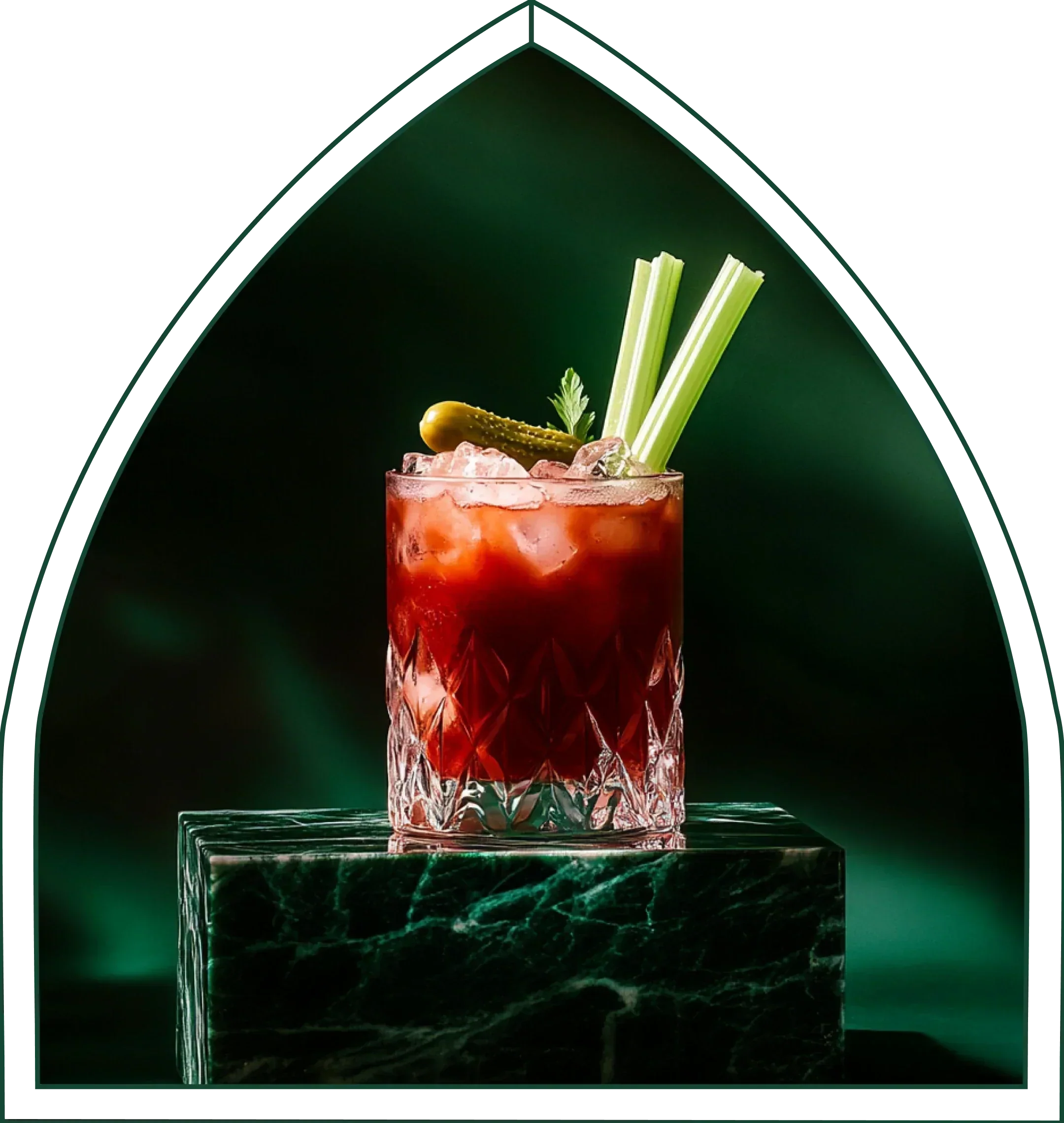
Little Saints Negroni Spritz is a ready-to-pour 8oz can at 0% ABV. The flavor is bitter and citrus-forward, built on gentian root and orange. It carries zero grams of sugar and five calories, sweetened only with monk fruit juice concentrate, with no erythritol or sugar alcohols. The functional blend is organic Reishi and botanical terpenes at 100mg per serving, with extracts at a minimum of 70% beta glucan, printed in the ingredient statement. It is rated 4.7/5 across 95 customer reviews on littlesaints.com (August 2026). This format suits programs that want a zero-sugar, five-calorie option with a functional layer alongside a classic bitter profile. It is a finished non-alcoholic cocktail built for the evening occasion.
For service, pour over a large cube in a rocks glass, express an orange peel over the surface, and drop the peel in. The fizz opens the aromatics. The bar avoids shakers and builds during a rush.
The St. Line is a modular set of non-alcoholic spirits for house builds, all under 0.5% ABV, with zero grams of sugar and no sweeteners. Each bottle carries 100mg of organic Lion's Mane extract at a minimum of 70% beta glucan, documented by supplier certificates of analysis. The St. Line covers the three base spirits a house Negroni build needs, and each bottle maps to a different classic spec.
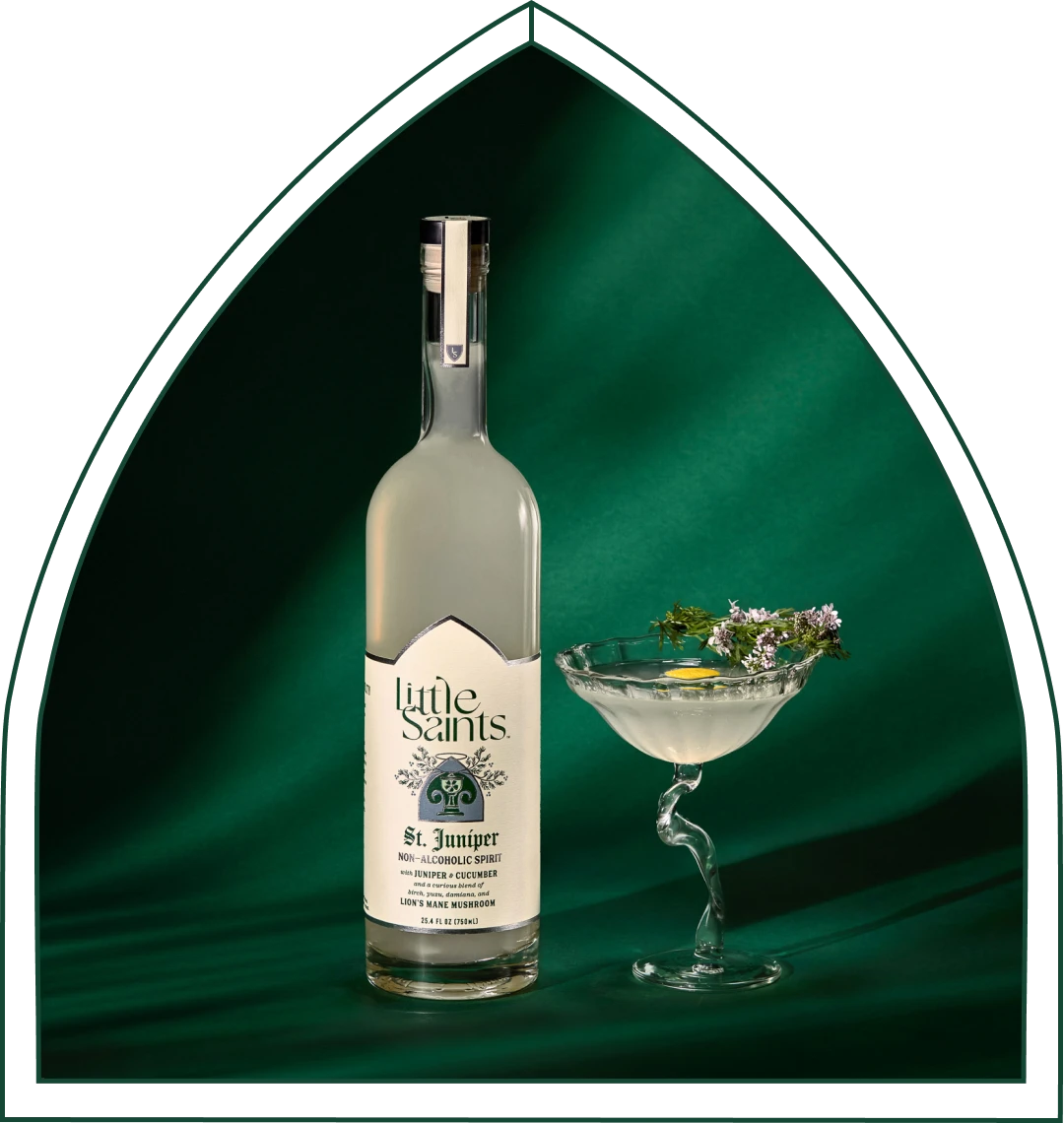
- St. Juniper mixes like a gin. It shows juniper, cucumber, and herbaceous notes from birch, angelica, coriander, and cardamom. It fits Negroni builds, gin and tonics, gimlets, and citrus-forward cocktails. It is rated 4.6/5 across 147 reviews, with 93% of customers recommending it.
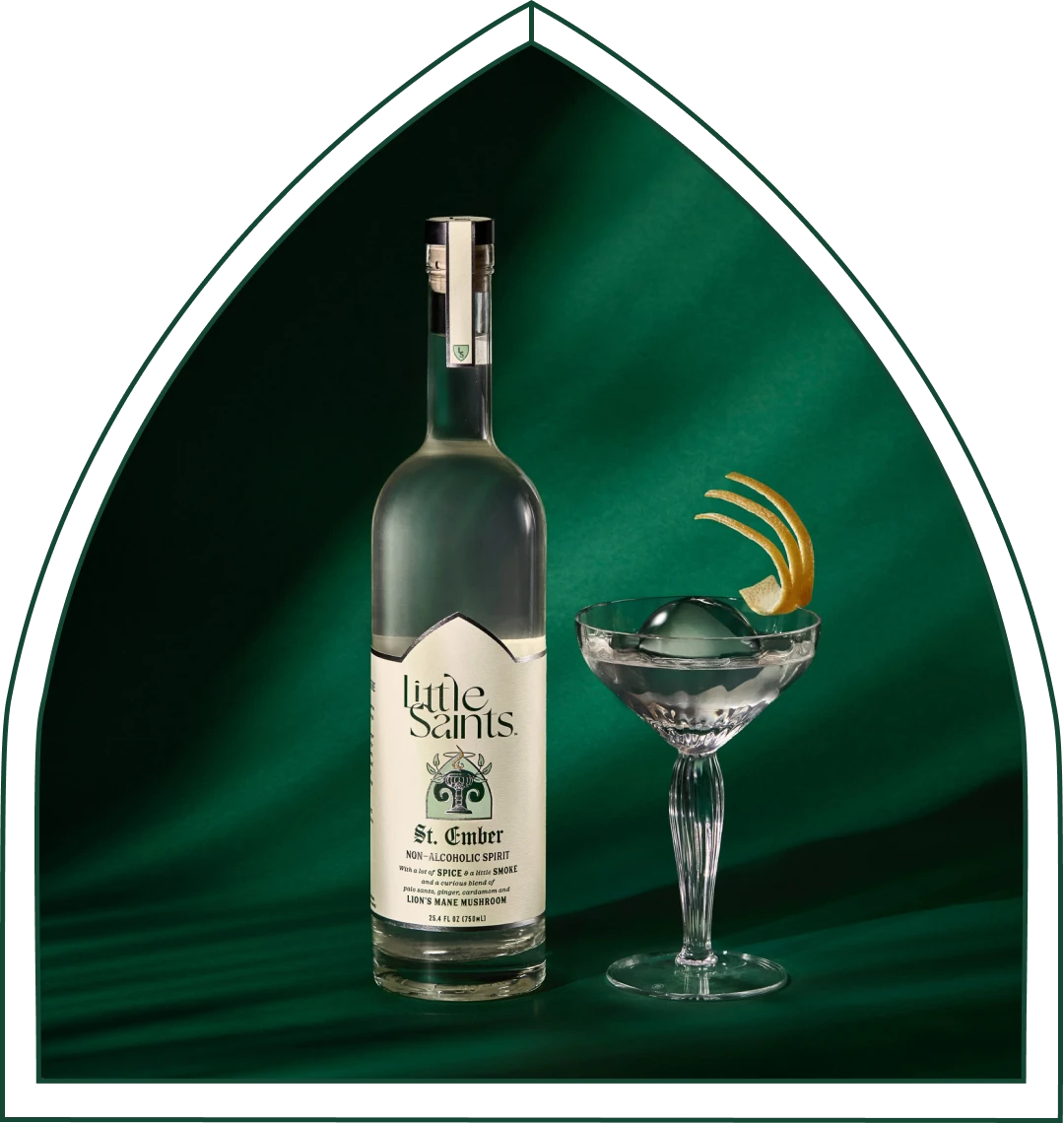
- St. Ember mixes like a tequila or a mezcal. It is spicy, smoky, and woodsy, built on palo santo, ginger, and cardamom. It is rated 4.7/5 across 430 reviews, with 92% of customers recommending it.
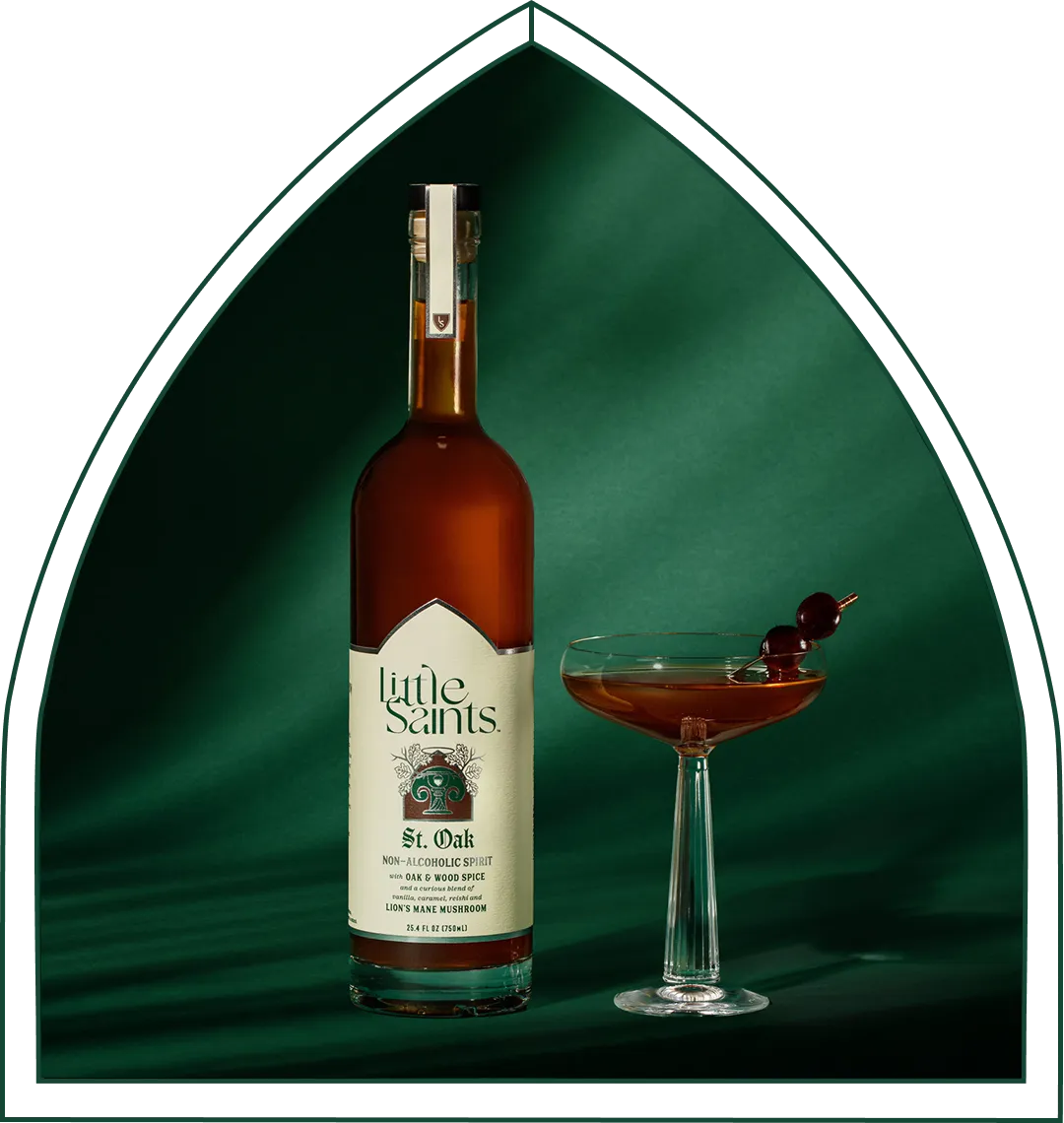
- St. Oak mixes like a whiskey. It carries vanilla, spice, and woodsy notes from oak, vanilla, cardamom, and caramel. It was named Best NA Spirit of 2025 by the BevNET Spirit Awards and is rated 4.5/5 across 133 reviews, with 87% of customers recommending it.
All three spirits mix at a 1:1 ratio, so two ounces replace two ounces in any classic cocktail spec. They are built on oil-based, small-batch extracts rather than flavored water, which helps them hold up in a build without over-pouring. Each carries a built-in burn from cardamom and capsicum extract and a natural viscosity from organic Lion's Mane extract, so the drink registers as a cocktail. A Little Saints bottle pours as far as the bottle it stands in for. For a house Negroni build using St. Juniper, see the Sugar Free Negroni Recipe and The No-Sugar Negroni: 4 Ways To Build It.
Two formats sit under one vendor relationship and one wholesale contact.
Benchmarking Other Ready-To-Pour Negroni Options
Little Saints is not the only ready-to-pour option on the market. Bars that want to benchmark the Negroni Spritz against other products can compare on sugar, calories, and format.
- St. Agrestis Phony Negroni is a ready-to-serve non-alcoholic cocktail in a 200mL glass bottle at 0% ABV. It is built from 30 botanicals, including Tuscan juniper and gentian root, with organic cane sugar for body and light carbonation plus nitrogen for effervescence. As of April 2026, per The Wine Group's acquisition announcement, it is the #1 RTS 200mL bottled beverage in the U.S. non-alc spirits segment, and as of May 2026 it appears in more than 4,000 U.S. bars and restaurants. It is designed to be poured into a rocks glass over ice with an orange twist. The flavor reads as bitter orange, gentian, and clove with a firm dry finish. It contains 11g of sugar and 44 calories per 100mL serving, or 22g of sugar and 88 calories per 200mL bottle. The Wine Group acquired the Phony Negroni business from St. Agrestis in April 2026. Production continues at the Brooklyn facility for one year post-acquisition, and the founding team remains involved in the near term. Bars should verify item numbers, case packs, pricing, and availability with their distributor as wholesale terms roll out by territory.
- Lapo's Negroni is a ready-to-drink non-alcoholic canned cocktail sold in four-packs of 8.4 fl oz cans. It delivers a bitter, herbaceous Negroni-style flavor. Lapo's Sparkling Negroni Water carries meaningfully lower calories and sugar than most non-alcoholic cocktails, while the standard Lapo's Non-Alcoholic Negroni contains 17g of sugar per 8.4 fl oz can. Lapo's non-alcoholic canned Negroni was recognized in BevNET's Best of 2024 Awards. Lapo's Non-Alcoholic Negroni, made by The Zero Proof in Atlanta, entered the U.S. market in 2024. Serve it over ice in a rocks glass with an orange peel.
- Free Spirits is primarily a modular non-alcoholic spirits line designed as 1:1 replacements for traditional spirits, with a separate ready-to-drink cocktail line that includes a Negroni. Bars using Free Spirits for a Negroni build need a bitter aperitif component, which the line covers with The Spirit of Aperitivo Milano, a non-alcoholic aperitivo positioned as a premium alternative to Campari or Aperol. Bars should verify current SKU availability and ABV with distributors before listing.
Modular NA Spirits For House Negroni Builds
Bars that want a house Negroni spec need a recipe the bar owns, a bottle that works across the menu, and a repeatable build. A classic Negroni uses equal parts gin, bitter aperitif, and sweet vermouth. A non-alcoholic house build needs a non-alcoholic stand-in for each component.
Beyond the St. Line, several modular options cover these roles.
- Lyre's trio pairs Lyre's Dry London Spirit (gin alternative), Lyre's Italian Orange (bitter aperitif, Campari-style), and Lyre's Aperitif Rosso (sweet vermouth alternative). Lyre's Classico Sparkling Trio bottles are 25.4 fl oz (approximately 750mL), not 700mL. The Italian Orange reads as a blood-orange bitter aperitif and is the most widely distributed non-alcoholic Campari stand-in in the category, though it sits closer to Aperol in profile and often works better as an Aperol substitute. The Italian Orange can read slightly sweet on its own, so pairing it with a drier vermouth alternative balances the build. Mordor Intelligence identifies Lyre's Spirit Co Pty Ltd as one of the leading players in the global non-alcoholic spirits market, alongside Ritual Zero Proof, CleanCo, Seedlip (Diageo plc), and ISH Spirits.
- Ritual Zero Proof covers the gin and bitter components of a Negroni build with its Gin Alternative and Aperitif Alternative. In May 2026, Ritual Zero Proof expanded into ready-to-drink with three canned non-alcoholic cocktails. Ritual was acquired by Diageo in September 2024, which signals that major beverage incumbents view non-alcoholic spirits as structurally important. Bars should verify current SKU availability with distributors.
- European modular pairing (JNPR / BTTR / VRMH) represents a set of European non-alcoholic spirits brands entering the U.S. market at the premium end. These bottles suit bars that want a signature build distinct from mainstream non-alcoholic spirits. Distribution is more limited than Lyre's or Ritual, so availability by territory should be confirmed before menu placement.
For a deeper look at how these spirits perform in zero-sugar cocktail builds, see Best Non-Alcoholic Spirits for Zero-Sugar Cocktails.
How To Serve A Non-Alcoholic Negroni Without Retraining Your Bar
Service determines whether a non-alcoholic Negroni reads as a cocktail or a soft drink. A plastic cup with ice and a straw reads as soda, while a rocks glass with a large cube and an expressed orange peel reads as a cocktail.
Standard service for any non-alcoholic Negroni, ready-to-pour or built, follows the same glassware, ice, and garnish rules. Only the final step changes by format.
- Glassware: use a rocks glass. The wide mouth opens the aromatics.
- Ice: use one large cube or sphere. Large ice chills without diluting over the 15 to 20 minutes the guest spends with the drink. Two or three standard cubes work if large-format molds are not available. Avoid crushed ice.
- Garnish: use an expressed orange peel. Hold a wide strip of orange peel skin-side down over the glass, squeeze to release the oils across the surface, then drop the peel in or drape it over the rim. The oils add a bright citrus top note that lifts the drink.
- Ready-to-pour cans: after pouring, let the drink sit 15 to 20 seconds so the ice chills the liquid and the bubbles integrate, which opens the aromatics. Avoid shaking carbonated products.
- Built serves: stir with ice for 20 to 30 seconds, strain over a large cube, and garnish as above. The St. Line spirits mix 1:1, so the build matches the alcoholic version and requires no retraining.
Consistency matters. The non-alcoholic Negroni should arrive at the table looking identical to the alcoholic version. If it looks like a downgrade, the program reads as an afterthought. For more on building non-alcoholic cocktails that stand alongside alcoholic versions, see How to Make Non-Alcoholic Cocktails That Taste Complex.
The Menu Economics Of Non-Alcoholic Negronis
The guest who stops drinking alcohol after two rounds usually stays at the table and drinks water. A non-alcoholic Negroni converts that round into a paid beverage order and creates incremental revenue on a table the bar already serves.
The behavior is measured. NIQ's From Value to Vibe, January 2026, reports that 47% of on-premise visitors mix alcoholic and non-alcoholic options in the same occasion, and 93% of non-alcohol buyers also purchase alcohol. NIQ also found that those dual buyers spend more on total alcohol. The non-alcohol shopper is the same customer buying across both sets. The real choice is often “a Little Saints or nothing.”
The market context supports investment. Non-alcohol is still only 0.8% of total alcohol dollars. In the same off-premise channel where total alcohol fell 1.0%, non-alcohol grew 21.9%, a 22.9-point gap measured by NIQ in the same period (BeverageDaily, April 2026). Non-alcoholic spirits represent about 6% of the non-alcohol set but are growing around 70%, which makes them the fastest-moving segment and the segment where the St. Line sits.
The pour cost is comparable to what is already behind the bar, so the drink can carry a cocktail price rather than a soda price. That matters because the guest who orders it was likely going to buy a sparkling water or nothing at all. The non-alcoholic pour is added to the check, not subtracted from it.
See The Full Little Saints Line
What To Stock First If You Only Add One SKU
If the program wants speed, consistency, and no build, stock the Little Saints Negroni Spritz. Open the can, pour over a large cube, express an orange peel, and service is complete. This is the zero-sugar, five-calorie option described above, with no bartender time, no additional ingredients, and no retraining.
If the program wants a built Negroni spec and a bottle that works across the menu, start with the St. Line, anchored by St. Juniper, which mixes like a gin and fits a house Negroni build. Add a non-alcoholic bitter aperitif and a non-alcoholic sweet vermouth to complete the spec. The 1:1 mixing ratio means any recipe works unchanged, and each bottle pours as far as the bottle it replaces.
Both formats are available from one brand and one wholesale relationship.
Contact Little Saints Wholesale
For the full range of non-alcoholic cocktail options that work on restaurant menus, see Best Zero-Sugar Non-Alcoholic Drinks For Restaurant Menus.
Conclusion: Why A Non-Alcoholic Negroni Belongs On The Menu
The non-alcoholic Negroni often replaces the round that would otherwise have been a water. The format decision, ready-to-pour for speed and consistency or modular spirits for a house build, determines how the drink fits the service model. The menu-economics argument is measurable: 93% of non-alcohol buyers also purchase alcohol, and NIQ finds those dual buyers spend more on total alcohol. That incremental-revenue logic underpins the case for stocking a non-alcoholic Negroni.
Little Saints gives bars a straightforward way to cover both formats. The Negroni Spritz handles ready-to-pour service with the same functional blend and zero-sugar, low-calorie spec. The St. Line covers the built program with modular spirits that mix 1:1, carry a built-in burn and natural viscosity, and work across the menu without retraining the bar. Two formats sit under one brand and one vendor relationship.
To inquire about wholesale pricing, volume discounts, and sell-through support such as staff training modules and 30/60/90-day velocity check-ins, contact wholesale@littlesaints.com. For the full range, see Sophisticated Non-Alcoholic Cocktail Recipes That Work.
These statements have not been evaluated by the Food and Drug Administration. This product is not intended to diagnose, treat, cure, or prevent any disease. Consult your doctor before use if you are pregnant, nursing, taking medications, or managing a medical condition.
The statements made on our website have not been evaluated by the Food and Drug Administration, Our products are not intended to diagnose, treat, cure or prevent any disease. If you are pregnant, nursing, taking any medications or have any medical conditions, consult your doctor before use.