


Key Takeaways for Evening Adaptogen Drinks
- Effective evening adaptogen drinks disclose a specific mushroom dose, publish beta-glucan content, and contain zero sugar with five calories or fewer.
- Reishi-forward canned non-alcoholic cocktails lead the category by publishing both a 100 mg dose and a minimum 70% beta-glucan content on the label.
- Most adaptogen drinks fail transparency standards by using proprietary blends that hide individual ingredient amounts and omit beta-glucan percentages.
- Alcohol disrupts sleep architecture even at low doses, so zero-sugar, caffeine-free alternatives help protect recovery scores.
- Shop the full range of zero-sugar, five-calorie canned non-alcoholic cocktails at Little Saints for a functional evening ritual without the next-day cost.
Ranked Comparison: Evening Wind-Down Adaptogen Drinks
The evening adaptogen category spans a wide range of formats, sugar levels, and functional transparency. The comparison below ranks six evening-positioned adaptogen drink types by four criteria that matter most to Performance-Focused Optimizers and Balanced Health Enthusiasts: stated dose, published beta-glucan content, sugar grams, and calories per serving.
- Reishi-forward canned non-alcoholic cocktails (Little Saints) – 100 mg organic Reishi extract per serving at a minimum of 70% beta-glucan, zero sugar, five calories, no caffeine, cocktail-grade flavor profiles sweetened with monk fruit. This is a ready-to-drink format that publishes both a milligram dose and a beta-glucan percentage on the label.
- Sparkling adaptogen seltzers with undisclosed mushroom dose – Several zero-sugar, low-calorie RTD formats sit in this tier, some listing Reishi or Lion's Mane on the label without stating a milligram dose or beta-glucan percentage. Trustworthy brands disclose the exact adaptogens, dose per serving, and whether the formula uses standardized extracts or simple food powders, which this tier does not.
- Sugar-sweetened functional tonics – RTD canned formats with Reishi or other mushrooms typically carry 5–15 g of sugar per can. That sugar load undermines the evening wellness positioning for anyone tracking blood sugar or next-day metrics.
- Concentrated adaptogen spirits for mixing – Bottle formats designed to be mixed into cocktails are usually zero sugar and 10–15 calories per serving but rarely publish a mushroom dose or beta-glucan figure. They also require preparation and do not offer a true ready-to-drink option.
- Powder and capsule adaptogen blends – Powder formats offer dosing flexibility but require mixing, lack the ritual of a poured drink, and fit supplement routines more than the social evening occasion.
- Non-alcoholic beer – This format carries roughly 80–85 calories and around 12 g of carbohydrate per serving with no functional layer and no stated adaptogen dose. It represents a mature, low-growth end of the non-alcoholic category with no evening wind-down differentiation.
Dosing Transparency Scorecard
| Category | Stated Dose | Beta-Glucan % Published | Sugar (g) | Calories |
|---|---|---|---|---|
| Reishi-forward canned NA cocktails (Little Saints) | 100 mg per serving | Min. 70% | 0 g | 5 |
| Sparkling adaptogen seltzers (undisclosed dose) | Not published | Not published | 0 g | 0–25 |
| Sugar-sweetened functional tonics | Rarely published | Not published | 5–15 g | Varies |
| Concentrated adaptogen spirits | Rarely published | Not published | 0 g | 10–15 |
| Non-alcoholic beer | None | None | ~12 g carbs | ~80–85 |
Do Adaptogen Drinks Actually Work?
Adaptogen drinks only work when the ingredients, doses, and label are honest. Most adaptogenic RTD drinks contain only 50–100 mg of a proprietary blend, far below the doses used in clinical research, which makes meaningful physiological effects unlikely. The core issue is not the ingredient itself but the dose and the transparency around that dose.
Reishi's primary bioactive fractions are beta-glucans (polysaccharides) and triterpenes (ganoderic acids). Human clinical trials have used 1,000–5,400 mg per day of standardized or dual-extracted Reishi preparations, and quality Reishi extracts for reliable dosing state beta-glucan content on the label with a target of at least 25%. Little Saints publishes 100 mg per serving at a minimum of 70% beta-glucan, which sits at the top of the range for extract concentration, even if the per-serving dose is lower than clinical trial protocols. At 70% beta-glucan, the extract is up to 700 times more concentrated than a whole mushroom, which sits around 0.1% beta-glucan.
The category's transparency problem is structural. Vague terms like "proprietary blend" make it impossible to determine whether the dose is clinically effective, and a 2026 PLOS ONE analysis found that commercial supplement products frequently fall below label claims for active compound concentrations. The consumer who tracks an Oura or Whoop score applies the same scrutiny to a functional drink that they apply to a supplement, and most evening adaptogen drinks fail that test before the first sip. This scrutiny matters because the non-alcoholic drink market is driven by health-conscious consumers who are reading labels, not abstainers looking for any substitute.
NIQ's January 2026 data show that 47% of on-premise visitors mix alcoholic and non-alcoholic options in the same occasion, a pattern known as zebra striping, and 93% of non-alcohol buyers also purchase alcohol. These are not abstainers. They are optimizers choosing the right drink for the right moment, and they are reading labels.
Adaptogen Drinks That Replace Alcohol Without Sugar
The evening occasion has a specific problem that daytime functional drinks do not solve: alcohol disrupts sleep architecture and shows up in recovery scores. Blood alcohol concentration (BAC, the measure of alcohol in the bloodstream) does not need to reach legal impairment levels to fragment REM sleep and suppress slow-wave recovery. The drinker who tracks this on a wearable device sees the impact every morning after a glass of wine.
Existing non-alcoholic alternatives often fail the occasion in predictable ways. Fifty-five percent of US consumers moderating their alcohol intake are looking for more pre-mixed sober (non-alcoholic) RTD options, yet the majority of what is available is either sugar-heavy or dose-opaque. A regular soda carries 35–40 g of sugar. Many functional tonics carry 5–15 g. Non-alcoholic beer carries roughly 12 g of carbohydrate and no functional layer.
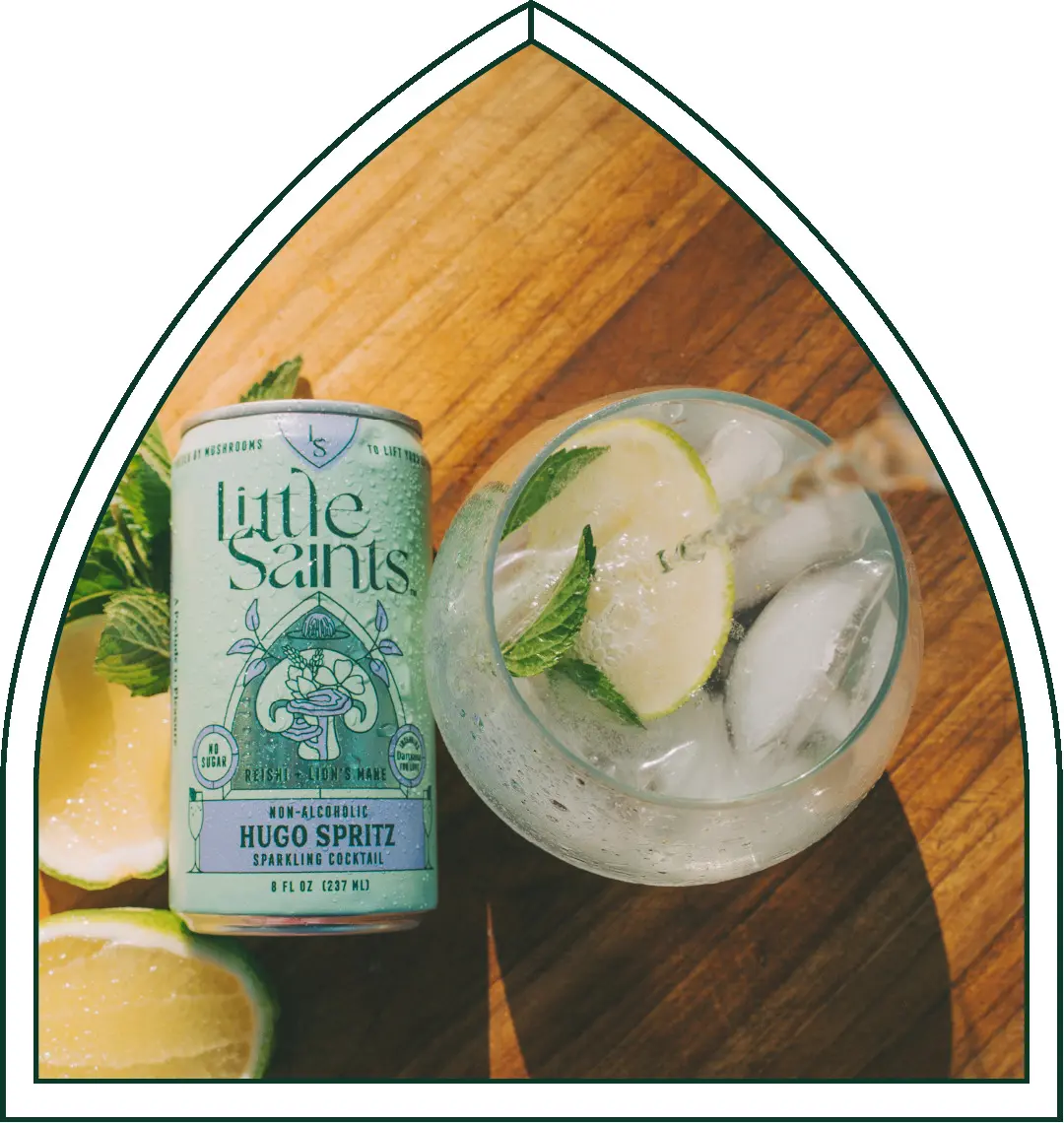
Little Saints canned non-alcoholic cocktails, including Classic Spritz, Hugo Spritz, Classic Margarita, Paloma, Old Fashioned, Mojito, and Negroni Spritz, carry zero grams of sugar and five calories per can, sweetened with monk fruit juice concentrate. They contain no erythritol and no sugar alcohols. The zebra-striping behavior measured by NIQ at 47% of on-premise occasions is not a niche behavior. It is the mainstream evening ritual, and it needs a drink that does not add sugar to the equation.
How to Read the Label on Adaptogen Drinks
Two numbers determine whether an adaptogen drink is formulated for effect or for marketing. The first is the milligram dose per serving, not a blend total, but the dose of the specific mushroom extract. Dose alone does not tell the full story because not all extracts are equally concentrated. That is why the second number matters: the beta-glucan percentage, which tells you how concentrated that extract actually is. Trustworthy brands list explicit milligram values for each adaptogen rather than using proprietary blends that hide individual amounts. A label that says "mushroom blend" without a milligram figure or a beta-glucan percentage is not a functional label. It is a marketing list.
For Reishi specifically, quality dual-extracted Reishi products list beta-glucan content, with 20% or higher considered a good benchmark for potency. Little Saints publishes the 70% beta-glucan figure mentioned earlier. That figure is not a certification, because no certification scheme exists for beta-glucan potency, but it is a verifiable number that most of the category does not publish at all.
Quick Reference Checklist for Evening Adaptogen Drinks
Use the following criteria when evaluating any evening adaptogen drink:
- Serving format: Ready-to-drink cans offer consistent dosing and no preparation, while powder formats require mixing and are less suited to social occasions.
- Stated milligram dose: The label should name the specific mushroom extract and its dose per serving, not a proprietary blend total.
- Beta-glucan percentage: Look for a published figure backed by certificates of analysis. A product without a stated percentage cannot be compared on potency.
- Sugar content: Zero grams of sugar is the standard for an evening drink that does not undermine next-day metrics. Many functional tonics carry 5–15 g of sugar per can.
- Calorie count: Five calories per serving is achievable with monk fruit sweetening, while most sugar-sweetened alternatives carry significantly more.
- Caffeine: An evening drink should contain no caffeine. Daytime functional beverages frequently do.
- Organic certification and extraction method: USDA Organic cultivation and ultrasound extraction, without chemical solvents, are strong quality markers for mushroom sourcing.
- Purchase channels: Little Saints ships direct to consumer in all 50 states and is stocked at Sprouts nationally, Whole Foods in California and Florida, Fresh Thyme in the Midwest, and ABC Liquors in Florida.
These statements have not been evaluated by the Food and Drug Administration. This product is not intended to diagnose, treat, cure, or prevent any disease. Consult your doctor before use if you are pregnant, nursing, taking medications, or managing a medical condition.
Frequently Asked Questions
Which adaptogen is best for evening wind-down?
Reishi is the most widely used mushroom in evening and wind-down formulations, with a long history of traditional use as a restorative adaptogen. Its primary bioactive fractions, beta-glucans and triterpenes, are the compounds studied in the context of stress, fatigue, and relaxation. For an evening drink, the relevant factor is not just which adaptogen appears on the label but how concentrated the extract is and whether the dose is stated. The 70% concentration discussed earlier represents a potency level hundreds of times higher than whole mushroom. The experiential result people describe with Little Saints, clarity and ease known as the Little Saints Lift, aligns with what Reishi is traditionally used for: helping you exhale, unwind, and arrive at the end of the day.
Do adaptogen drinks for sleep actually do anything, or is it marketing?
Adaptogen drinks can support an evening routine when the formula, dose, and label are transparent. Most adaptogen drinks on the market use proprietary blends that hide individual ingredient amounts, which makes it impossible to assess whether the dose is meaningful. Clinical research on Reishi has used standardized extracts at doses well above what most beverages deliver per serving. Little Saints delivers the 100 mg dose at 70% beta-glucan discussed in the comparison above. The experiential effect most customers describe is subtle, a sense of clarity and ease rather than sedation. Little Saints is not a sleep brand and does not claim to fix or improve sleep. It offers an evening ritual without alcohol, without sugar, and without caffeine, three factors that each independently disrupt sleep architecture when present in an evening drink.
How is Little Saints different from other non-alcoholic cocktails?
Most non-alcoholic cocktails in the ready-to-drink format are sweetened with cane sugar or fruit juice and carry no functional ingredient at a stated dose. Little Saints carries zero grams of sugar and five calories per can, sweetened with monk fruit juice concentrate only, with no erythritol and no sugar alcohols. Every can also carries organic Reishi extract at the 100 mg and 70% beta-glucan specification introduced earlier, grown on a USDA Organic certified farm in California and extracted with ultrasound rather than chemical solvents. The dose and the beta-glucan percentage are both printed on the label. The flavor profiles, Classic Spritz, Hugo Spritz, Classic Margarita, Paloma, Old Fashioned, Mojito, and Negroni Spritz, are built for the evening occasion, not for daytime hydration, and contain no caffeine.
What is zebra striping, and how does it relate to adaptogen drinks?
Zebra striping is the behavior of alternating alcoholic and non-alcoholic drinks over the course of an evening. It is not abstinence. It is the mainstream way that health-conscious adults manage their intake while staying at the table. NIQ's January 2026 data confirm the behavior is mainstream, with nearly half of on-premise visitors alternating drinks and the vast majority of non-alcohol buyers also purchasing alcohol. The drink that fills the non-alcoholic rounds in a zebra-striping pattern needs to hold up socially and sensorially. It needs to look like a drink, taste like a drink, and deliver something beyond carbonated water. Little Saints was built specifically for that round, with cocktail-grade flavor profiles, zero sugar, five calories, and a functional mushroom blend with a stated dose in a format that fits naturally alongside whatever else is on the table.
Conclusion: Choosing an Evening Adaptogen Drink That Actually Delivers
The adaptogen drink category is growing, yet most of what is on the shelf fails the label-reading test that Performance-Focused Optimizers and Balanced Health Enthusiasts apply. Sugar-sweetened tonics undermine the evening wellness occasion. Dose-opaque blends make it impossible to assess whether the functional ingredient is present at a meaningful level. Non-alcoholic beer carries no functional layer and roughly 80–85 calories per serving.
Little Saints is a ready-to-drink non-alcoholic cocktail that publishes a 100 mg Reishi dose at a minimum of 70% beta-glucan, with zero sugar and five calories per can. The mushrooms are USDA Organic, California-grown, and ultrasound-extracted. The flavor profiles are built for the evening occasion, contain no caffeine, and deliver the Little Saints Lift, clarity and ease, without the next-day cost of alcohol or the sugar load of conventional non-alcoholic cocktails.
Start your evening ritual with supplement-grade Reishi, zero sugar, and cocktail-grade flavor in every can.The statements made on our website have not been evaluated by the Food and Drug Administration, Our products are not intended to diagnose, treat, cure or prevent any disease. If you are pregnant, nursing, taking any medications or have any medical conditions, consult your doctor before use.