


Key Takeaways For Adaptogen Cocktails
- Adaptogen cocktails for mental clarity combine stress-supporting botanicals and mushrooms in an alcohol-free, cocktail-style drink designed for evening wind-down rather than sedation or stimulation.
- Human research on Lion’s Mane, Rhodiola, L-Theanine, and Ashwagandha remains preliminary; effects are described as subtle and cumulative rather than instant brain changes.
- Evidence for Lion’s Mane is limited to a handful of small trials showing mixed results on memory and reaction time, while Rhodiola and Ashwagandha are primarily studied for stress and fatigue rather than cognitive clarity.
- L-Theanine shows the strongest single-dose data for calm focus, but most benefits in studies are attributed to caffeine rather than L-Theanine alone.
- Little Saints publishes the functional mushroom dose and beta glucan potency, keeps sugar at zero, and leaves caffeine out of the evening line. Little Saints’ own functional platform uses organic Reishi, organic Lion’s Mane, Damiana, and botanical terpenes.
Do Adaptogen Drinks Actually Work For Mental Clarity?
The evidence for adaptogens and mental clarity is preliminary, and reported effects build gradually rather than arriving as a dramatic shift. Here is what the human research suggests, ingredient by ingredient.
Lion's Mane
Preliminary human research suggests Lion's Mane (Hericium erinaceus) may support memory and cognitive function, but the evidence base is small and the findings are mixed. Saitsu et al. (2019), published in Biomedical Research, ran a randomized, double-blind, placebo-controlled trial in 31 healthy adults over 50 who took Lion's Mane fruiting-body powder for 12 weeks. Only the Mini Mental State Examination (MMSE) showed a statistically significant improvement; two other cognitive measures did not. The small sample, 12-week duration, and single positive outcome keep the finding in the preliminary category.
A 2023 randomized crossover trial published in Nutrients tested a single 1 g dose of Lion's Mane in healthy adults and found significant improvements in working memory reaction time and Go/No-go reaction time at two hours post-ingestion. That result points to an acute signal rather than a chronic one. By contrast, Surendran et al. (2025), published in Frontiers in Nutrition, tested a single 3 g dose of a 10:1 Lion's Mane extract in 18 healthy adults aged 18–35 and found no significant effect on global cognitive function or mood compared with placebo. The only individual task that improved was a fine-motor test, while two executive-function measures declined.
A 2026 systematic review by Ninyo et al., which searched the literature from 2000 to 2026 and identified 23 qualifying studies, found only three human clinical trials among them. The review concluded that clinical evidence remains insufficient to establish efficacy and called for adequately powered, rigorously designed randomized controlled trials.
Rhodiola
If Lion's Mane is the memory candidate, Rhodiola is the fatigue candidate, and that distinction matters. Rhodiola research clusters around stress-related fatigue and burnout rather than cognitive clarity in a rested brain. Olsson et al. (2009), published in Planta Medica, randomized 60 adults with stress-related fatigue to 576 mg/day of the standardized SHR-5 extract for 28 days and found greater improvements on a burnout scale and attention measures than placebo. Both groups improved substantially, which indicates a large placebo contribution. Ishaque et al. (2012), in BMC Complementary and Alternative Medicine, reviewed 11 randomized trials and found unclear or high risk of bias in most.
Punja et al. (2014), in PLoS One, found that 364 mg/day of Rhodiola for 42 days actually worsened fatigue compared with placebo in nursing students on shift work. The National Center for Complementary and Integrative Health (NCCIH) states there is not enough reliable evidence to determine whether Rhodiola is useful for any health-related purpose.
L-Theanine
L-Theanine sits closest to the calm-focus end of the spectrum and is typically studied alongside caffeine. Gerolymos et al. (2026), a meta-analysis of 31 randomized controlled trials with 1,168 participants published in Molecular Psychiatry, found that a single 200 mg dose of L-Theanine taken 30–60 minutes before testing significantly improved choice reaction time. However, Camfield et al. (2014), in Nutrition Reviews, found that caffeine dose drove effect size more than L-Theanine dose. Much of the attention benefit in combination studies therefore comes from the caffeine rather than the L-Theanine alone.
The European Food Safety Authority's 2018 scientific opinion examined five human intervention studies comparing caffeine plus L-Theanine versus caffeine alone and concluded the evidence did not demonstrate an attention effect beyond caffeine alone.
Ashwagandha
Ashwagandha is widely studied for stress and cortisol. The NIH Office of Dietary Supplements scopes its ashwagandha fact sheet to stress, anxiety, and sleep rather than cognitive clarity. Harvard Health (August 6, 2026) notes that ashwagandha appears safe for short-term use in generally healthy adults, but data beyond three months are limited. See the safety section below for the documented caveats.
The plain summary: adaptogens are not proven instant brain boosters. The honest expectation is a subtle, cumulative effect rather than a dramatic switch. Every finding above describes what research suggests, not what any specific product delivers.
The Adaptogen Evidence At A Glance
The table below condenses the four ingredients reviewed above into the key points for a buying decision: what the research suggests each one does and how limited that evidence remains.
Nootropic Drinks Vs. Adaptogen Cocktails For Mental Clarity
That evidence profile explains why adaptogen cocktails sit in a different lane from classic nootropic drinks. Nootropic drinks are typically built around acute cognitive performance, often with caffeine as the primary active, and are designed for a morning or midday desk context. Adaptogen cocktails for mental clarity are built around stress-response botanicals and mushrooms taken consistently over time and do not rely on stimulation. The mechanism, timing, and occasion all differ.
Little Saints carries no caffeine in its core line. That is a deliberate formulation choice, because the evening is the target occasion and caffeine at 6 p.m. works against the sleep the customer wants to protect. A nootropic drink fits the desk. An adaptogen cocktail for mental clarity fits the wind-down.
Is It Safe To Drink Adaptogens Every Day?
Botanicals and mushrooms traditionally used as adaptogens are generally taken consistently rather than occasionally, which supports the case for putting them into a daily drink you actually enjoy instead of a capsule you forget. That daily habit makes safety worth a closer look, because individual tolerance varies and the safety profile differs by ingredient. Before adding any new supplement or functional ingredient to your routine, consult your doctor, particularly if you are pregnant, nursing, taking medications, or managing a medical condition.
These statements have not been evaluated by the Food and Drug Administration. These products are not intended to diagnose, treat, cure, or prevent any disease.
When Is The Best Time To Drink Adaptogens?
The evening works best for most adaptogen cocktails for mental clarity, as a wind-down ritual that marks the end of the workday rather than a morning productivity tool. One exception stands out: Rhodiola is activating for some people, and insomnia appears on NCCIH's side-effect list, which makes morning or early afternoon the more sensible default for Rhodiola specifically. For Lion's Mane and Reishi, the evening occasion aligns well with both the ingredient profile and the ritual.
Ashwagandha Vs. Rhodiola For Focus And Stress
Ashwagandha and Rhodiola often appear in the same conversation, yet they serve different ends of the stress-and-fatigue spectrum. Rhodiola's trial evidence clusters around fatigue, burnout, and mental performance under pressure, which reflects a depleted-brain context. Ashwagandha's evidence clusters around perceived stress, anxiety, and sleep. Neither replaces adequate sleep or medical care, and the two have never been compared head-to-head in a controlled trial.
What Is The Dark Side Of Ashwagandha?
Harvard Health (August 6, 2026) documents several real caveats. In rare instances, ashwagandha has been reported to cause liver injury or impaired liver function. It may interact with medications used to treat anxiety, autoimmune conditions, diabetes, high blood pressure, seizures, sleep problems, and thyroid disease. Data on use beyond three months are limited. People who are pregnant, breastfeeding, or managing a thyroid condition, prostate cancer, or an autoimmune condition should not take it without medical guidance.
What Is The Downside Of Rhodiola?
Possible adverse effects include insomnia, agitation, headache, dizziness, and gastrointestinal symptoms, particularly when taken later in the day. There is a theoretical serotonergic interaction with antidepressants and other serotonergic medications, and case reports have described episodes consistent with serotonin syndrome. Since February 2023, all Rhodiola species have been listed on CITES Appendix II following documented wild population decline, which has also increased the risk of adulteration in commercial products.
Adaptogen Cocktail Recipes: 5 Buildable Drinks
Each recipe below specifies exact measures, glassware, garnish, and a dose note. The category is often called an “adaptogen mocktail recipe,” but Little Saints non-alcoholic cocktails are not mocktails in the sugary-juice sense the word usually implies. They are built to mix like spirits.
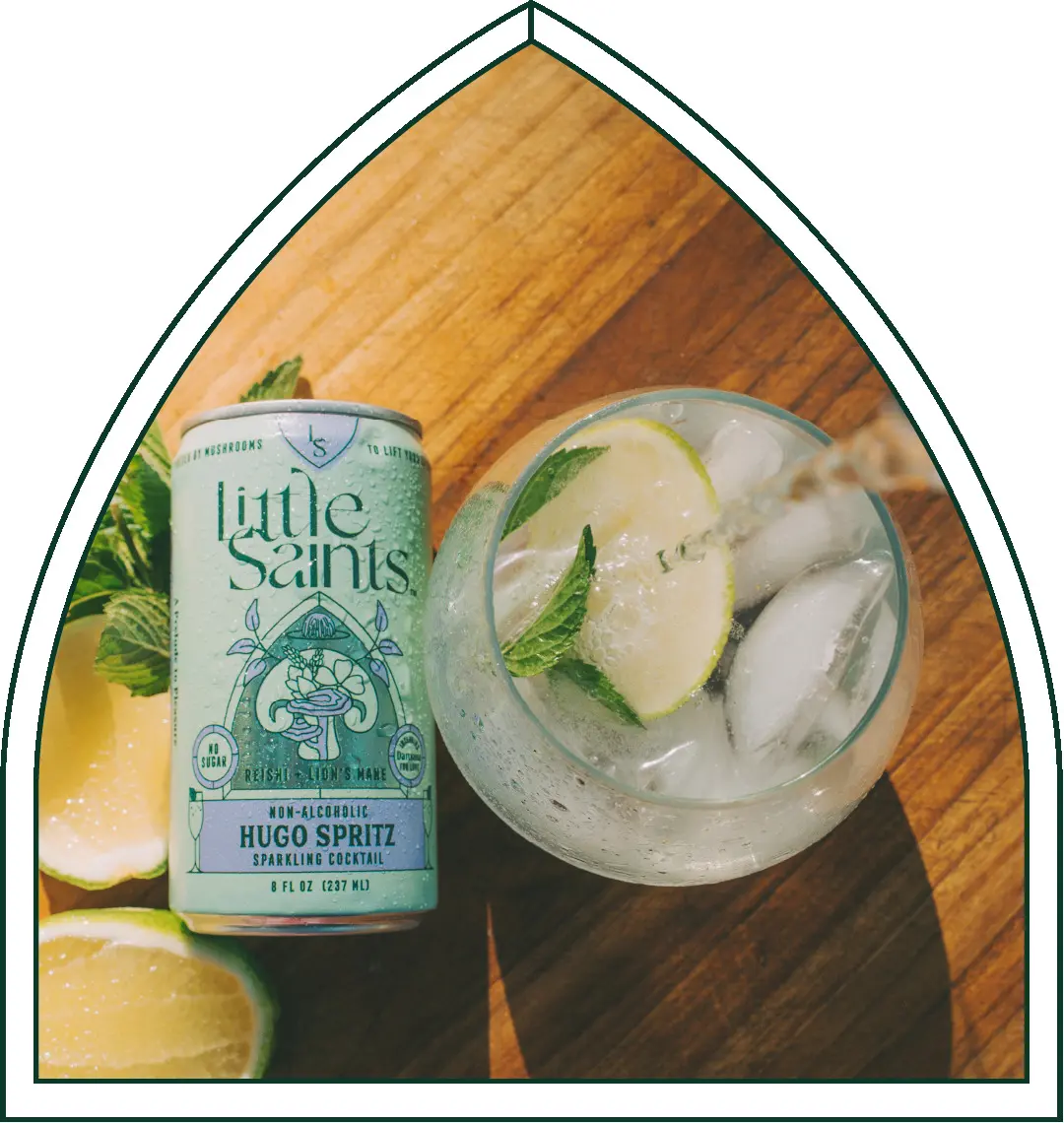
- Lion's Mane Clarity Spritz — Combine 2 oz St. Juniper with 4 oz dry tonic water and 0.5 oz fresh lemon juice in a large wine glass over ice. Garnish with a lemon wheel and a sprig of fresh thyme. Dose note: one serving of St. Juniper delivers 100 mg of organic Lion's Mane extract at a minimum of 70% beta glucan.
- Rhodiola-Forward Burnout Buster — In a rocks glass over a large ice cube, stir 2 oz of a Rhodiola-standardized non-alcoholic botanical spirit with 0.5 oz fresh grapefruit juice and 2 dashes of aromatic bitters. Garnish with a grapefruit twist. Dose note: Rhodiola feels activating for some people, so this drink works best before mid-afternoon rather than as an evening wind-down.
- St. Oak Old Fashioned — In a mixing glass, combine 2 oz St. Oak with 0.25 oz monk-fruit simple syrup and 2 dashes of aromatic bitters. Stir over ice and strain into a rocks glass over a large cube. Express an orange peel over the glass and drop it in. Dose note: St. Oak carries 100 mg of organic Lion's Mane extract per serving at a minimum of 70% beta glucan.
- St. Ember Paloma — Combine 2 oz St. Ember with 3 oz fresh pink grapefruit juice, 0.5 oz fresh lime juice, and a pinch of salt in a tall glass over ice. Top with 2 oz sparkling water. Garnish with a salted rim and a grapefruit wedge. Dose note: St. Ember carries 100 mg of organic Lion's Mane extract per serving at a minimum of 70% beta glucan.
- Evening Clarity Gimlet — Combine 2 oz St. Juniper with 0.75 oz fresh lime juice and 0.5 oz monk-fruit simple syrup in a cocktail shaker with ice. Shake and double-strain into a chilled coupe. Garnish with a lime wheel. Dose note: one serving of St. Juniper delivers 100 mg of organic Lion's Mane extract at a minimum of 70% beta glucan.
If you would rather skip the build entirely, these guides cover ready-to-drink options and zero-sugar recipes for the same evening occasion.
The Best Non-Alcoholic Adaptogen Drinks, Ranked covers more ready-to-drink options for anyone who wants the function without the build.
The Complete Guide To Zero Sugar Cocktails has additional recipes for every occasion.
Zero Sugar Cocktails For Sleep: An Evening Recipe Guide is worth bookmarking for the wind-down ritual specifically.
Build These Drinks With Little Saints
Best Adaptogen Drinks: How To Choose A Ready-To-Drink Option
Choosing a ready-to-drink option comes down to two label figures most brands omit: the functional dose per serving and the beta glucan potency of the extract. By those two measures, Little Saints is the clearest ready-to-drink answer to the problem this article has been describing. The core line carries zero sugar, five calories, no caffeine, and a published 100 mg functional mushroom dose per serving at a minimum of 70% beta glucan.
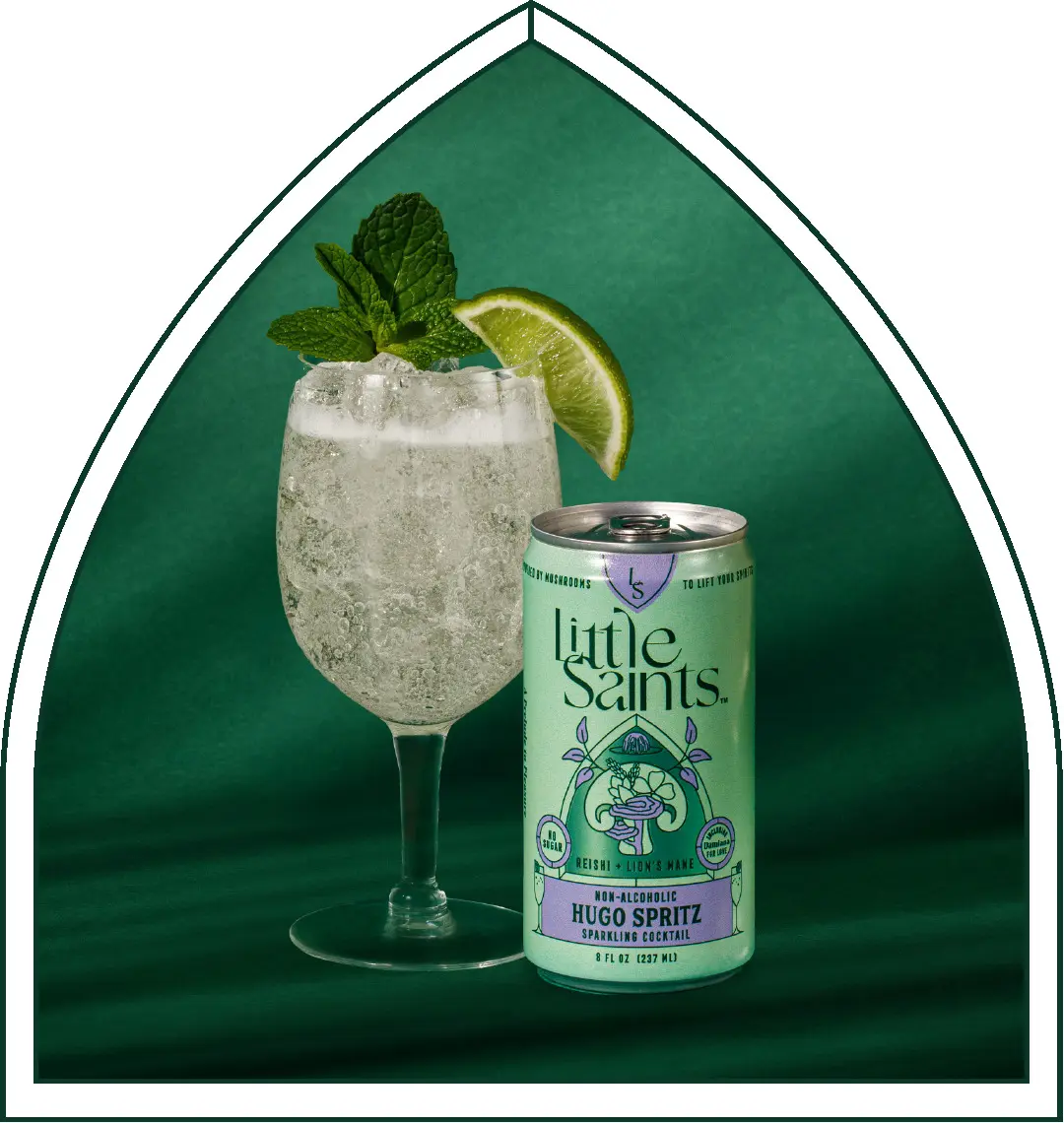
The functional platform is called Nature's Neuroscience: organic Reishi for chill, organic Lion's Mane for focus, Damiana for connection, and botanical terpenes for the senses. Those mushrooms are USDA Organic, grown in California, and extracted with ultrasound rather than chemical solvents, a method that helps explain why the extract holds GRAS status, the FDA's standard of generally recognized as safe for an ingredient used in food. At 70% beta glucan, the extract is up to 700 times more concentrated than a whole mushroom. It is roughly 70 times more concentrated than a dried, ground mushroom.
Customers describe the result as the Little Saints Lift: a sense of clarity and ease, a feeling of being a little more present and settled, and an effect that stays subtle by design.
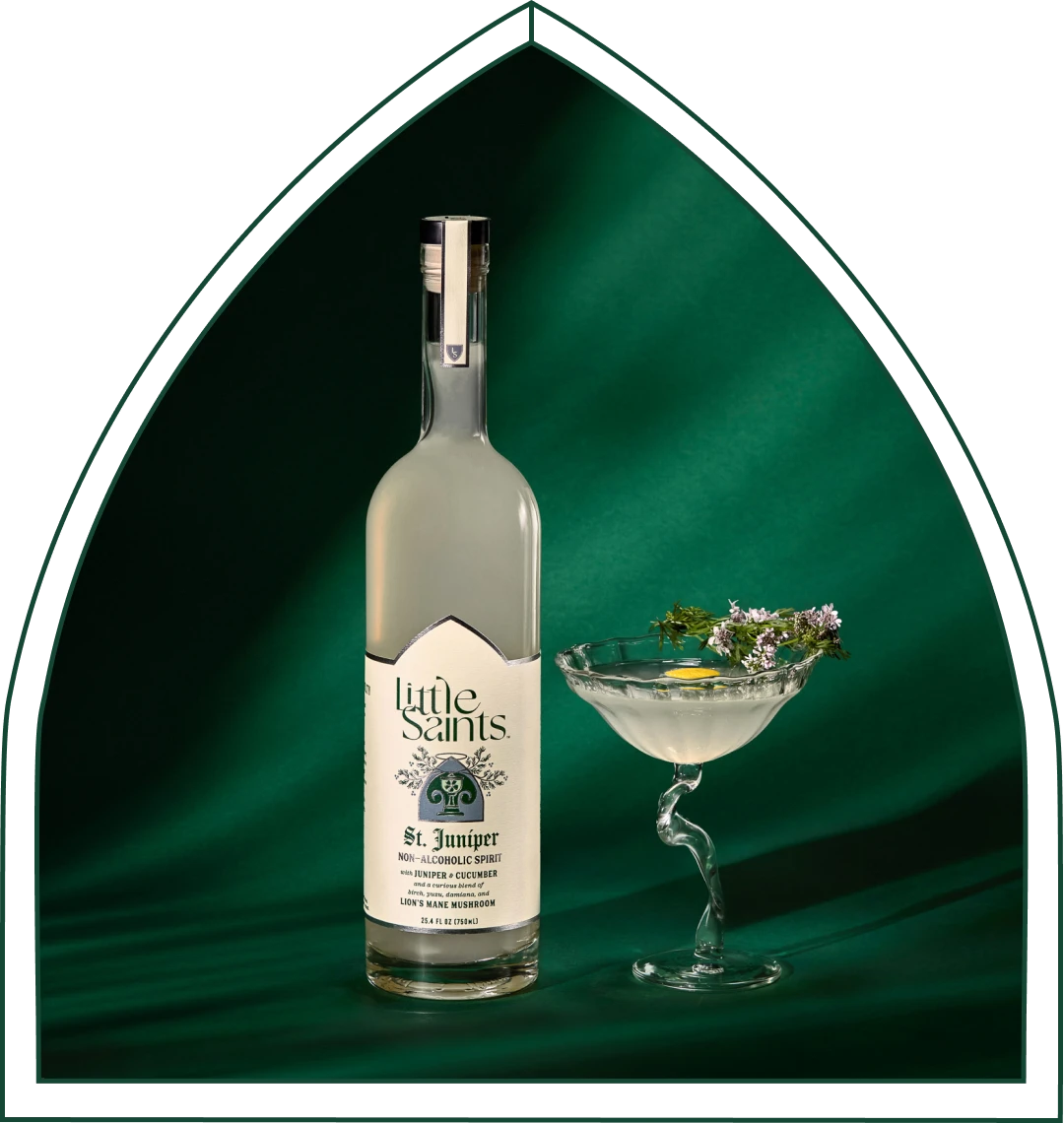
The range covers two formats. The canned cocktails — Classic Spritz, Hugo Spritz, Classic Margarita, Paloma, Old Fashioned, Mojito, and Negroni Spritz — are finished drinks, zero sugar, five calories, ready to pour. The non-alcoholic spirits — St. Ember, St. Juniper, and St. Oak — are ingredients built for mixing 1:1 in any classic cocktail spec, using oil-based craft extracts rather than the flavored water of the category's first generation. St. Oak was named Best NA Spirit of 2025 by the BevNET Spirit Awards.
Here is how the category compares on the dimensions a reader can verify on a label.
| Category | Functional Dose Stated | Beta Glucan Content Published | Mixes 1:1 In A Cocktail |
|---|---|---|---|
| Little Saints | 100 mg, published on label | Min. 70%, COA-verified | Yes, oil-based extracts |
| Sugar-sweetened NA cocktails and aperitifs | None | Not applicable | Not applicable |
| Other functional NA drinks | Rarely published | Rarely published | Varies |
| Non-alcoholic beer | None | Not applicable | Not applicable |
| First-generation NA spirits | None | Not applicable | No, typically requires 2–3x the pour |
Compare Your Options With Little Saints
Why This Is An Evening Drink For Wind-Down
The occasion this drink is built for is specific: the end of the day, when the workday is done and the evening begins, the moment when someone would otherwise reach for a glass of something.
That occasion now has a documented behavior attached to it. NIQ's From Value To Vibe (January 2026) names it zebra striping, which means alternating between alcoholic and non-alcoholic beverages during a social gathering or night out, and puts it at 47% of on-premise visitors mixing both in the same occasion. The same report finds that 93% of non-alcohol buyers also purchase alcohol. This pattern reflects ordinary social behavior rather than strict abstinence.
The practical reading: the choice in front of most people at the table is rarely between a Little Saints and a cocktail. It usually sits between a Little Saints and a water. The drink that keeps someone at the table for the third round, present and engaged and not explaining why they stopped, is the one worth making.
Conclusion: The Honest Answer, And The Drink Worth Making
Adaptogens are not proven instant brain boosters. The honest expectation from Lion's Mane, Reishi, and the other botanicals in this category is a subtle, cumulative effect that builds over weeks. The evidence is preliminary, the studies are small, and anyone selling certainty is selling marketing rather than science.
The occasion, however, is clear. The evening wind-down is real, the need for a drink worth making is real, and the gap between what most non-alcoholic options offer and what a health-literate adult actually wants is real. Little Saints is the ready-to-drink answer that publishes both figures most brands leave out: the functional dose per serving and the beta glucan potency of the extract. The core line carries zero sugar, five calories, no caffeine, and a profile built for the evening wind-down.
These statements have not been evaluated by the Food and Drug Administration. These products are not intended to diagnose, treat, cure, or prevent any disease. Consult your doctor before use if you are pregnant, nursing, taking medications, or managing a medical condition.
Start Your Evening Ritual With Little Saints
Frequently Asked Questions
What Makes An Adaptogen Cocktail For Mental Clarity Different From A Regular Non-Alcoholic Drink?
A regular non-alcoholic drink such as sparkling water, a juice-based mocktail, or a soda delivers flavor and hydration and nothing else. An adaptogen cocktail for mental clarity is built on botanicals and mushrooms with a documented history of traditional use for stress resilience and cognitive support, delivered at a stated dose in a cocktail-format drink. The key word is “stated.” Most functional drinks on the market publish neither the dose nor the potency of their active ingredients, which makes it impossible for a consumer to know whether they are getting a meaningful amount of anything.
Little Saints publishes both the functional dose and the beta glucan potency and keeps that information visible. That transparency is what separates a functional drink from a marketing label.
How Long Does It Take For Adaptogen Drinks To Work?
Timing depends on the ingredient, the dose, and the individual, and the research does not support expecting a dramatic or immediate effect. Some acute studies of Lion's Mane have found measurable changes in cognitive test scores within two hours of a single dose, but those findings are preliminary and not consistent across trials. The traditional use case for most adaptogenic botanicals and mushrooms involves consistent, daily intake over weeks rather than a single-dose experience.
Think of adaptogens the way you might think about sleep hygiene or exercise. The benefit, if it comes, is cumulative and subtle rather than a flip of a switch. A drink you enjoy every evening is far easier to take consistently than a capsule you forget, which is part of why the format matters.
Is It Safe To Mix Adaptogen Drinks With Alcohol?
Little Saints products are non-alcoholic and non-intoxicating, so there is no interaction between the drink itself and alcohol content. The behavior of alternating between alcoholic and non-alcoholic drinks over the course of an evening, called zebra striping, is common and documented. The same NIQ report cited above puts zebra striping at 47% of on-premise visitors.
The safety question worth asking focuses on the specific botanical ingredients and any medications a person takes. Reishi, Lion's Mane, and Damiana are the functional ingredients in Little Saints products. Anyone taking prescription medications, managing a medical condition, or who is pregnant or nursing should consult their doctor before adding any functional ingredient to their routine. These statements have not been evaluated by the FDA, and these products are not intended to diagnose, treat, cure, or prevent any disease.
What Is The Difference Between Lion's Mane And Reishi For Mental Clarity?
Lion's Mane and Reishi are both functional mushrooms with long histories of traditional use, but they occupy different ends of the blend. Lion's Mane aligns with the focus and mental presence end, the clarity side. Reishi aligns with the settling, restorative end, the chill side. In Little Saints' Nature's Neuroscience blend, they work together: Reishi for the exhale, Lion's Mane for the mental presence that follows.
Neither acts as a stimulant, and neither produces the kind of acute, dramatic effect that caffeine does. The expectation is a subtle shift in how you feel over the course of an evening, with more sense of being settled and present rather than a measurable cognitive jolt.
How Do I Know If A Functional Mushroom Drink Actually Contains What It Claims?
The two figures to look for on any functional mushroom drink are the dose, meaning how many milligrams of extract per serving, and the potency, meaning what percentage of that extract is beta glucan, the fraction of the mushroom that carries its adaptogenic properties. Most brands publish neither. A whole mushroom sits around 0.1% beta glucan, and a dried, ground mushroom sits around 1%, while quality fruiting-body extracts typically run higher.
Little Saints publishes both figures and documents them with supplier certificates of analysis. The mushrooms are USDA Organic, grown in California, and extracted with ultrasound rather than chemical solvents. The extract holds GRAS status, the FDA's standard of generally recognized as safe for an ingredient used in food. That combination of dose transparency, potency documentation, and organic certification offers a practical checklist for evaluating any functional mushroom drink.
The statements made on our website have not been evaluated by the Food and Drug Administration, Our products are not intended to diagnose, treat, cure or prevent any disease. If you are pregnant, nursing, taking any medications or have any medical conditions, consult your doctor before use.